Direct to Consumer (DTC) Fulfillment Services
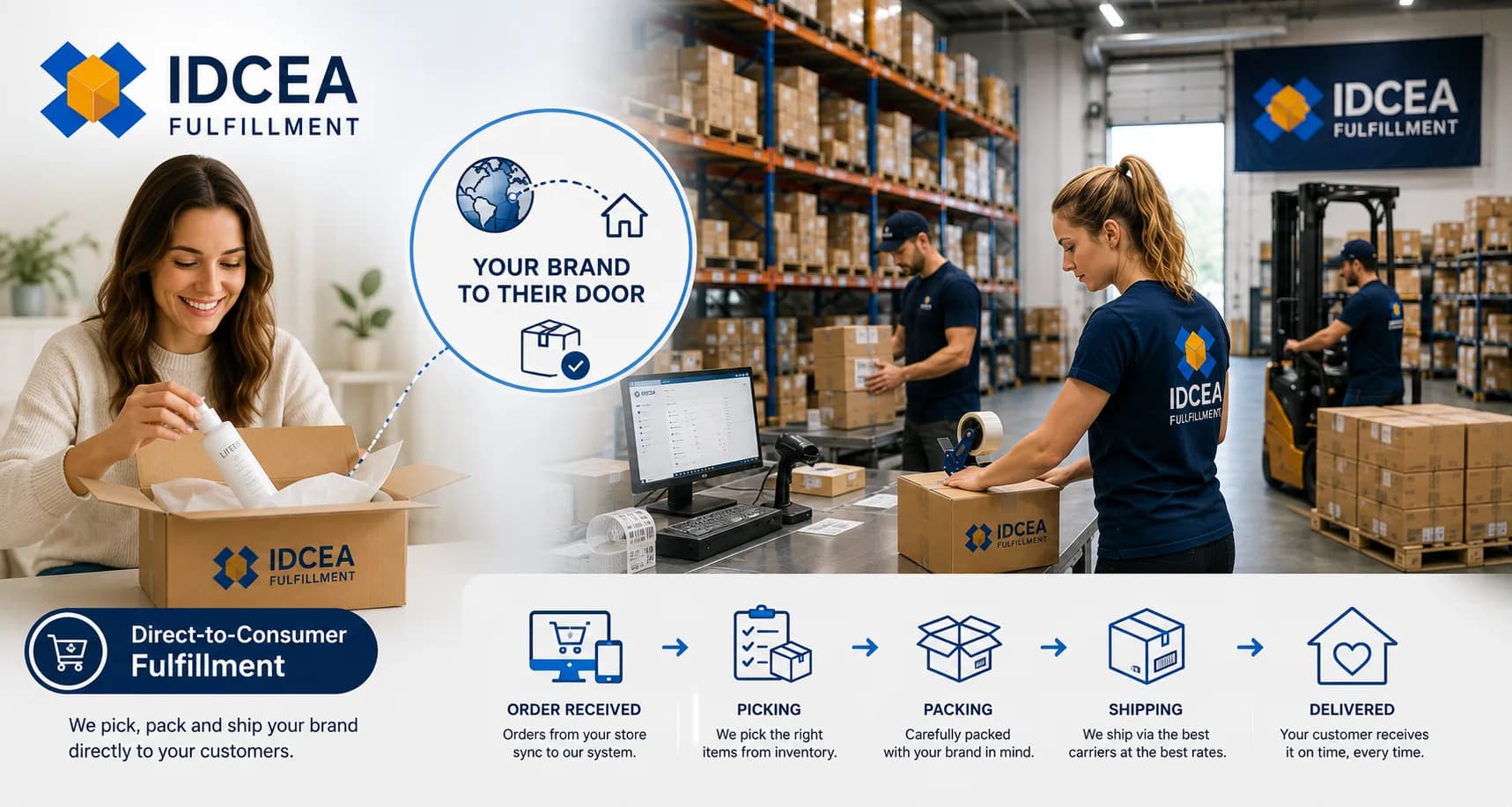
Direct to consumer fulfillment services for brands that ship straight to the customer — branded packaging and unboxing, kitting and bundles, subscription cycles, direct shipping and returns. DTC fulfillment run as its own workflow, not a parcel afterthought.
- Branded packaging & inserts
- Kitting & bundles
- Subscription cycles
- Consumer returns
- Branded unboxing
- Gift sets & bundles
- Subscription boxes
- Direct shipping
- Returns
The box your customer opens is part of the brand
For a DTC brand, the delivery is part of the product. Direct-to-consumer fulfillment isn't just moving a parcel from A to B: it decides what box the customer opens, whether the insert you paid to print is actually in it, whether the bundle they ordered arrives as a bundle, and how the return goes when something doesn't fit. Every one of those is a brand decision that gets executed on a warehouse floor.
IDCEA runs DTC fulfillment services with that in mind — your packaging and kit recipes set up once, orders picked and packed to them, shipped on a rate-shopped label with tracking back to the buyer, and returns received, inspected and dispositioned rather than piled in a corner. The work runs through partner warehouses in Southern California.
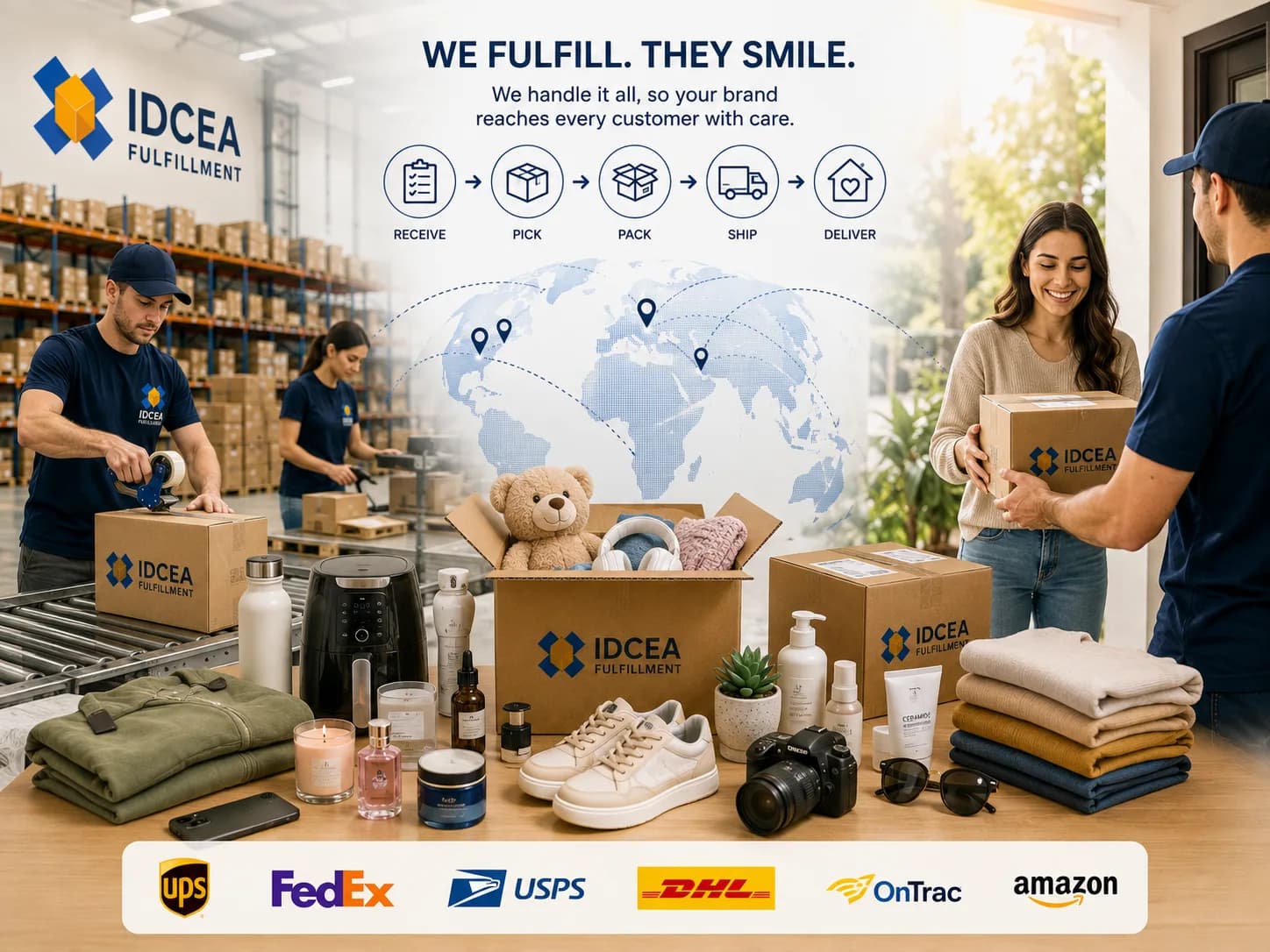
DTC Fulfillment Services We Provide
Branded Packaging & Unboxing
Branded packaging fulfillment using the materials you supply — your boxes and mailers, tissue, crinkle, stickers, cards and printed inserts — packed to a written spec so the tenth thousand order opens the same way the first one did.
Kitting, Bundles & Gift Sets
DTC kitting services for multi-item sets: bundles, gift sets, starter kits and promotional packs assembled ahead of demand and stocked as one SKU, so a bundle picks as a single item instead of three separate ones.
Subscription Box Fulfillment
Subscription box fulfillment on your cycle — the month's kit recipe built and staged before the ship window, then picked and shipped against the recurring order file, with the variant and insert rules applied per segment where your program has them.
DTC Pick & Pack
Direct-to-consumer pick and pack: the SKU located and scan-verified at the shelf, kits and bundles assembled where the order calls for them, packed in your materials, and the carrier label applied.
Shipping & Tracking
Carrier and service compared per parcel on weight, dimensions and destination before the label is bought, then tracking pushed back to your store so the customer gets the update without you sending it. Transit time is the carrier's, and we quote it as theirs.
DTC Returns Processing
DTC returns management: returns received against the original order, inspected against your criteria, and dispositioned — back to sellable stock, into quarantine for review, routed to recovery, or written off — with the reason recorded either way.
Inventory Visibility
DTC inventory management by SKU and location, with on-hand, allocated and available counts visible to you — including components held for kits, which is where subscription programs usually run short first.
How Our DTC Fulfillment Process Works
Define the experience
Your packaging, inserts and kit recipes are documented once and set up as this brand's pack standard.
Receive & store
Product and packaging materials are received, counted and stored by SKU — including insert stock, which runs out quietly if nobody counts it.
Pick, kit & pack
Orders are picked and scan-verified, kits and bundles assembled where needed, and packed to your spec in your materials.
Ship & track
A rate-shopped label is bought and tracking syncs back to your store and your customer. Orders in before the daily cutoff go out the same business day when stock is on hand.
Handle returns
Returns are received against the original order, inspected and dispositioned — restock, quarantine, recovery or write-off — keeping the count accurate.
Branded Fulfillment & Custom Unboxing
Branded fulfillment is mostly a documentation problem, not a creative one. The creative work is already done — you have the box, the tissue, the card, the sticker placement. What breaks at scale is that none of it is written down anywhere a picker can follow, so the presentation drifts as volume grows and staff changes.
We build the pack spec with you and keep it with the account: which mailer for which order size, how the tissue is folded, where the sticker goes, which insert goes in which order and when a promotional card is swapped out. Custom unboxing fulfillment then becomes repeatable rather than dependent on who is on the bench that day.
- Your branded boxes, mailers, tissue, filler and tape — or plain materials where you'd rather not carry the cost
- Printed inserts, cards and samples, with rules for which orders receive them
- Product placement and presentation documented per order type
- Insert and packaging stock counted as inventory, so it's reordered before it runs out
Subscription Box Fulfillment
Subscription fulfillment has a different shape from ordinary DTC: almost all the volume lands in a few days, and the contents change every cycle. That means the work is front-loaded — this month's kit recipe has to be received, counted, assembled and staged before the ship window opens, not while it's open.
We build the cycle's kits ahead of the run, hold them as a single SKU, then pick and ship against the recurring order file. Where your program has segments — different variants, different inserts, skip and swap rules — those are applied per order rather than sorted out by hand on the day.
- STEP 1Kit recipe received
- STEP 2Counted & assembled
- STEP 3Staged as one SKU
- STEP 4Ship window opens
- STEP 5Picked per order file
- STEP 6Segment rules applied
Fulfillment That Extends the Brand Experience
The parcel is the only physical thing most of your customers ever get from you, and four operational details decide how it lands: whether the right item is in the box, whether it's presented the way you intended, when it arrives, and how simple it is to send back.
We can control three of those directly — accuracy at the pick, presentation at the pack bench, and how a return is handled when it comes back. The fourth, transit time, belongs to the carrier, so we treat it as a choice to be made well per shipment rather than a promise to make on their behalf. What we won't do is quote you a retention or conversion lift; that depends on your product and your marketing, not your 3PL.
Four details that decide how a parcel lands
- Right item
- Ours — accuracy at the pick.
- Presentation
- Ours — the pack spec at the bench.
- Returns
- Ours — how a return is handled when it comes back.
- Transit time
- The carrier's — chosen well per shipment, not promised.
DTC vs. Retail & B2B Fulfillment
The same inventory can ship three ways, and the rules change completely depending on who is receiving it:
DTC Fulfillment for Growing Consumer Brands
The moment outsourcing starts to pay is usually the moment packing orders stops being a task and starts being the reason nothing else gets done. The brands this page is written for:
DTC Fulfillment in Southern California
The work runs through partner warehouses in the Los Angeles, Ontario and Riverside corridor. IDCEA staffs and coordinates the operation; we do not own the buildings, and we would rather say so than imply facilities we do not operate.
For a DTC brand the position helps on both ends: imported product and packaging clear the Los Angeles and Long Beach ports and go into pickable stock without a cross-country leg first, and Southern California sits in the nearest ground zones for California and the western states — how many days that becomes depends on the carrier and service each parcel ships with.
The corridor
- Los Angeles
- Closest to the LA / Long Beach port complex.
- Ontario
- Inland Empire, on the I-10 and I-15 freight corridors.
- Riverside
- Inland Empire, for space and outbound lanes.
Why consumer brands run DTC fulfillment through IDCEA
On-brand unboxing
A written pack spec per account, so presentation survives volume growth and staff turnover.Subscription-ready
Cycle kits built and staged before the ship window, then shipped against the recurring order file.Returns worked, not stockpiled
Inspected and dispositioned with the reason recorded — restocked where sellable, routed to our sister marketplace (yowdo.com) where there's value to recover, written off where there isn't.What you pay for — and what you don't
Billed per activity
- Pick & pack — first item per order, plus each additional item
- Storage — from day 8, by cubic metre and inventory age
- Receiving — per carton or per container
- Returns — per package received, inspection per unit
- Packaging materials — billed on the materials used
- Carrier postage — at the applicable carrier rate
Not billed
- Setup fee
- Monthly minimum
- Basic WMS / OMS access
- Storage for the first 7 days
Three steps to get started
Check the starting rates
See what pick and pack starts at and what drives the rest of the invoice, so you know what to send us.View 3PL pricing →Request a quote
Tell us your SKUs, channels and any special handling, and we'll confirm how the work runs and what it costs for your account.Request a quote →Send your inventory
Ship your first inbound to the Southern California partner warehouse we assign; it's received and counted against your paperwork before any work starts.Common questions
Fulfillment for brands shipping straight to the end customer rather than through a retailer. Alongside picking, packing and shipping, it covers the parts the customer actually sees: branded packaging, inserts, kits and bundles, and how a return is handled.
It holds your product and your packaging materials, takes orders from your store, picks and assembles them, packs them to your brand spec, ships them to the consumer, syncs tracking, and receives and dispositions returns.
They overlap heavily. Ecommerce fulfillment is framed around the channels — storefronts, marketplaces, integrations, one pooled inventory across all of them. DTC is framed around the brand-to-consumer experience: packaging, inserts, kits, subscription cycles and consumer returns. Most brands need both, and it's one operation either way.
DTC ships eaches to consumers in your packaging under carrier rules. Retail ships cases and pallets to a retailer's DC or stores under that retailer's routing guide — carton labels, ASN, pallet patterns and booked appointments. Different picking, packing and paperwork.
We pack in the branded boxes, mailers, tissue and filler you supply, following a written pack spec set up for your account. We don't print or manufacture packaging; you source it and we hold it as inventory.
Yes — cards, samples and printed inserts, with rules for which orders receive which insert. Insert stock is counted as inventory so it gets reordered before it runs out mid-campaign.
Yes. Kits, bundles, gift sets and promotional packs are assembled to your recipe and held as a single SKU, so the bundle picks as one item.
Yes. The cycle's kits are built and staged before the ship window, then picked and shipped against the recurring order file, with variant and insert rules applied per segment.
Yes — recurring cycles are handled as a scheduled run rather than as ad-hoc orders, including skip, swap and segment rules where your program has them.
Yes. Returns are received against the original order, inspected against your criteria, and dispositioned to restock, quarantine, recovery or write-off, with the reason recorded.
Sellable returns go back into stock. Where an item can't be resold as new but still has value, it can be routed to our sister marketplace (yowdo.com). Not every return has recoverable value, and we report those as write-offs rather than quietly restocking them.
Yes — product, packaging materials and insert stock, tracked by SKU and location with on-hand, allocated and available counts visible to you.
Orders received before our daily cutoff are packed the same business day when stock is on hand; we'll confirm the exact cutoff for your account. How quickly the parcel then arrives is the carrier's transit time, not something we can promise on their behalf.
In Southern California, through partner warehouses in the Los Angeles, Ontario and Riverside corridor — near the ports for imported product and in the nearest ground zones for California and the western states.
It depends on your order profile — orders per month, units and kits per order, packaging complexity, storage and shipping lanes. The 3PL pricing page explains how each charge is built up, and the cost calculator estimates from your own numbers.
Start a quote
Tell us roughly how much you ship and we'll quote dtc fulfillment on the published rates — the same ones on the pricing page.
Picking a range just pre-fills the form — you can change it there, and the published rates are the same whichever range you fall in.
Where to go next
3PL fulfillment services
The parent service: storage, pick and pack, multi-channel orders and returns.
3PL pricing
How receiving, storage, pick-pack and shipping charges are built up.
Ecommerce fulfillment
The channel side: storefront and marketplace orders off one pooled inventory.
Retail fulfillment
When the same product starts shipping into retail DCs and stores instead.
Sister marketplace (yowdo.com)
Where returned and excess stock goes when it can't go back on the shelf — handled by our sister site.