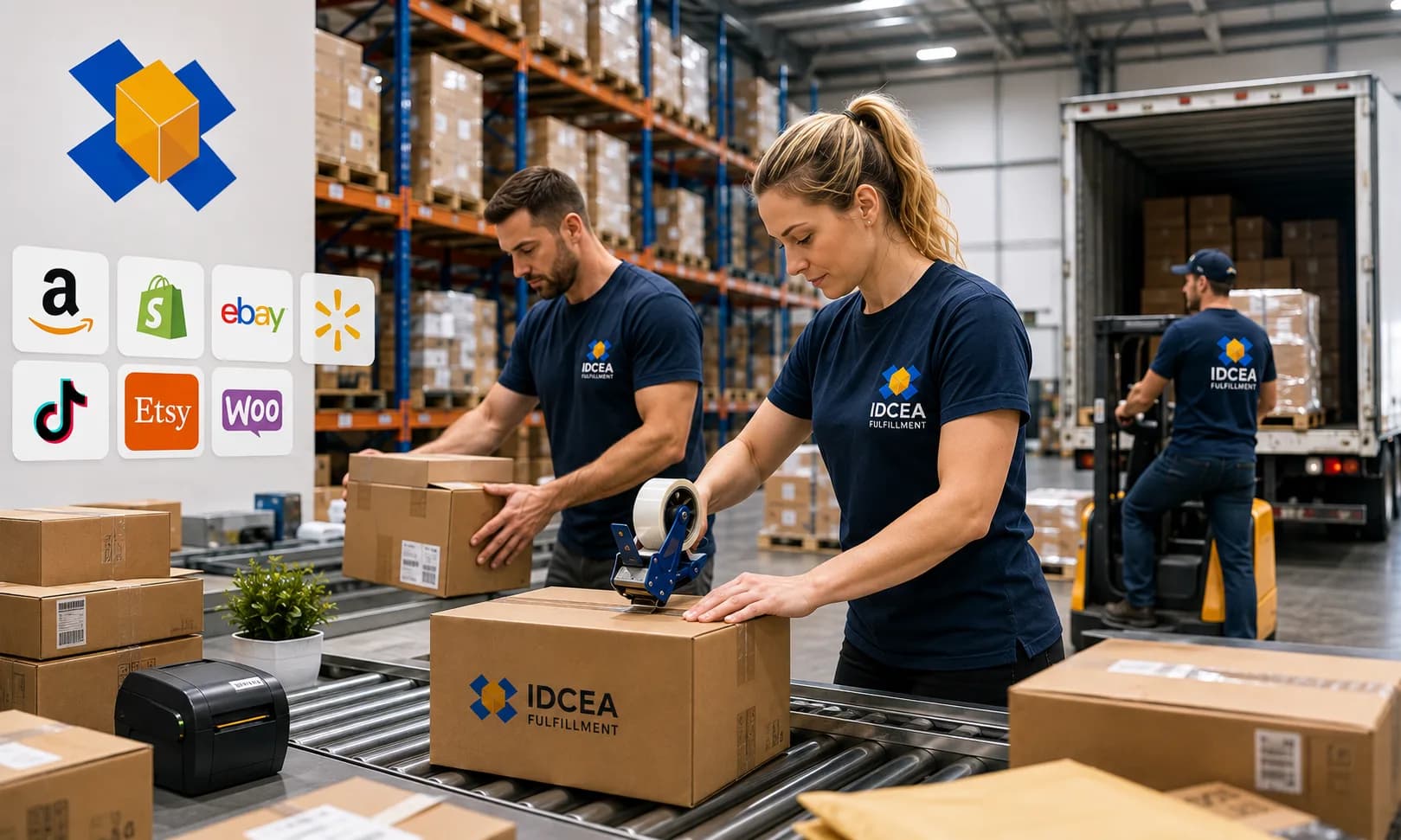
Ecommerce Fulfillment Services & Marketplace 3PL
Ecommerce fulfillment services for growing brands — a 3PL for Shopify, Amazon, eBay and Walmart sellers. Connect your store and marketplaces, hold inventory in one pool, and have every order picked, packed, shipped and tracked back.
- One inventory pool across channels
- Scan-verified pick & pack
- Rate-shopped label on every order
- LA · Ontario · Riverside
- Shopify
- Amazon
- eBay
- Walmart
- TikTok Shop
- Etsy
- WooCommerce
Direct integration where the platform offers one, scheduled order feed where it doesn't — confirmed per channel before you commit.
One pool of inventory, every channel you sell on
Ecommerce fulfillment services are the layer between the checkout button and the doorstep. Your store takes the order; something still has to hold the inventory, find the SKU, pack it, buy the label, hand it to a carrier and push tracking back to the buyer — for every order, every day, across every channel you sell on. Past a few dozen orders a day that stops being a spare-room job and starts being an operation.
IDCEA runs that operation as your ecommerce 3PL: inventory received and stored by SKU, orders pulled in from your store and marketplaces into one pooled stock, picked and packed, shipped on a rate-shopped label, tracked back to the customer, and returns received and dispositioned. The work runs through partner warehouses in Southern California.
Ecommerce Fulfillment Services We Provide
Inventory Receiving & Storage
Ecommerce warehousing and fulfillment from the dock in: inbound cartons or containers counted against your ASN, SKUs put away in bin, shelf or pallet locations sized to how they sell, and counts visible to you rather than reconciled at month end.
Ecommerce Order Processing
Orders come in from your store and marketplaces without anyone exporting a spreadsheet — by direct integration where the platform offers one, or by scheduled feed where it doesn't. Orders received before the daily cutoff are processed the same business day, stock permitting.
Pick & Pack Fulfillment
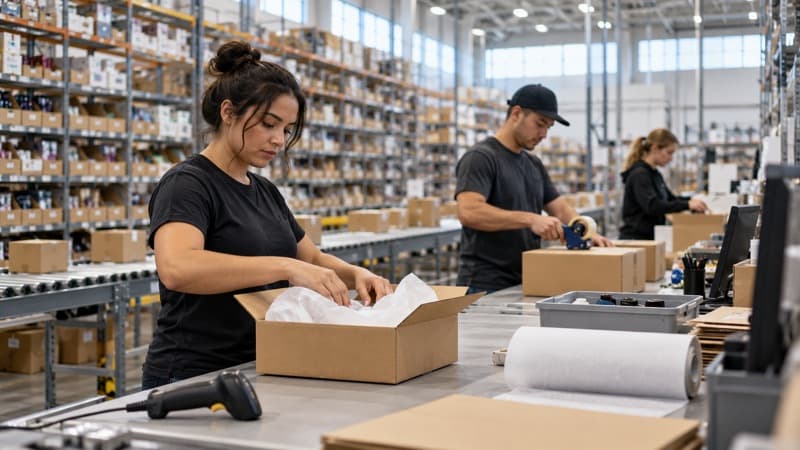
Ecommerce pick and pack against the order: SKU located, quantity picked and verified by scan, packed in a box sized to the contents, and the carrier label applied. Single-item, multi-item and bundle orders all run the same line.
Packaging & Kitting
Standard cartons and mailers billed on the materials used, or your own approved shipping-ready packaging, branded boxes, tissue and inserts where you supply them. Kitting and assembly for bundles, multi-packs and pre-built sets, so a bundle picks as one SKU instead of three.
Shipping & Tracking
Ecommerce shipping fulfillment across multiple carriers with rate shopping per order — service and price compared before the label is bought — then tracking numbers pushed back to your store so the buyer gets the update without you sending it.
Returns Processing
Ecommerce returns management: returns received against the original order, inspected, and dispositioned to restock, quarantine or disposal per your rules, with what came back and why reported rather than left in a corner.
How Our Ecommerce Fulfillment Process Works
Connect
Your store and marketplaces are connected, SKUs mapped, and inventory set up as one pooled stock rather than a pile per channel.
Send inventory
Inbound freight or parcels are received, counted against the paperwork and put away by SKU.
Orders flow in
Orders import automatically as they're placed — no manual export, no copy-paste, no re-keying addresses.
Pick & pack
Each order is picked, scan-verified and packed; orders received before the daily cutoff go out the same business day when stock is on hand.
Ship & track
A rate-shopped carrier label is bought, the parcel is manifested, and tracking syncs back to your store and your customer.
Multi-Channel Ecommerce Fulfillment
Most brands don't sell in one place any more. The same SKU goes out through a Shopify or WooCommerce storefront, a marketplace listing, and increasingly a social storefront — and the fastest way to lose money on all three is to keep a separate pile of stock for each. Multi-channel fulfillment means one pooled inventory, one set of counts, and orders from every channel drawing on it.
We fulfill orders from the channels you sell on — Shopify, Amazon, eBay, Walmart, TikTok Shop, Etsy and WooCommerce among them. How a channel connects depends on the channel: some offer a direct integration, others are handled by scheduled order feed. We'll tell you which applies to yours before you commit, rather than calling everything an integration.
- One inventory pool across every storefront and marketplace
- Orders imported as placed, not exported by hand at the end of the day
- Counts updated as orders ship, so channels stop overselling each other
- Marketplace fulfillment run to each channel's shipping and tracking requirements
Ecommerce Warehousing & Inventory Management
Ecommerce inventory management is the unglamorous half of fulfillment and the half that decides whether the rest works. SKUs are received and put away in locations sized to how they move — fast movers in pick-face bins, slow or bulky stock in reserve racking — and counts are tied to locations rather than to a total sitting in a spreadsheet.
You see what's on hand, what's allocated to open orders and what's left to sell, which is what makes a reorder decision possible before a listing goes out of stock. For inventory that isn't shipping this month, our warehouse storage service holds it at bulk rates instead of in pick-face space you're paying a premium for.
Three numbers per SKU
- On hand
- Units physically in their locations right now.
- Allocated
- Units already committed to open orders.
- Available
- What's left to sell — the number your channels should show.
Pick & Pack Fulfillment for Ecommerce Orders
Here is what actually happens between a customer clicking buy and the parcel arriving. The order lands in the queue with its SKUs and quantities. A picker is routed to the locations holding them and scans each item, so a wrong SKU is caught at the shelf rather than by the buyer. The order is packed in a carton or mailer sized to the contents — oversized boxes cost dimensional weight, undersized ones cost damage.
The carrier and service are rate-shopped for that parcel's weight, dimensions and destination, the label is bought and applied, the parcel is manifested onto the day's outbound, and the tracking number goes back to your store. Online order fulfillment is that loop, repeated accurately, thousands of times.
- STEP 1Order queued
- STEP 2Picker routed
- STEP 3Scan verified
- STEP 4Right-size pack
- STEP 5Rate-shopped label
- STEP 6Manifested
- STEP 7Tracking synced
Ecommerce Returns Processing
Returns are part of ecommerce, not an exception to it. A returned parcel is received against the original order so you know which sale it belongs to, inspected against your criteria, and then dispositioned — back to sellable stock, into quarantine for review, or written off.
Not everything that comes back can be resold, and we don't pretend otherwise: opened, used or damaged goods are reported as what they are rather than quietly restocked. You get the disposition and the reason, which over a few months is the data that tells you whether the problem is the product, the listing or the packaging.
Where a return ends up
- Restock
- Back to sellable inventory when it passes inspection.
- Quarantine
- Held for your review when it's unclear.
- Write-off
- Opened, used or damaged — reported as such, not quietly restocked.
- STEP 1Received against the order
- STEP 2Inspected
- STEP 3Dispositioned
- STEP 4Reported with the reason
Ecommerce Fulfillment for Growing Brands
The point at which outsourcing makes sense is usually the point at which packing orders stops being the founder's job and starts being the reason nothing else gets done. The brands and businesses this page is written for:
What Ecommerce Fulfillment Costs
Fulfillment pricing isn't one number, and any 3PL quoting one before seeing your order profile is guessing. Cost is built from the pieces of work your orders actually create:
- Receiving — by carton or container on inbound
- Storage — by the cubic metres your SKUs occupy, per day, after the first free days
- Pick and pack — per order, plus additional units in the same order
- Packaging — standard materials, or your own branded materials
- Shipping — the carrier's charge for that parcel, weight and zone
- Returns and special projects — per return, or per project
Published rates at a glance
No setup fee. No monthly minimum. Transparent fulfillment pricing.
Packaging materials and carrier postage are billed separately.
Ecommerce Fulfillment in Southern California
The work runs through partner warehouses in the Los Angeles, Ontario and Riverside corridor. IDCEA staffs and coordinates the operation; we do not own the buildings, and we would rather say so than imply facilities we do not operate.
For an ecommerce brand the position matters on both ends: imported inventory clears the Los Angeles and Long Beach ports and goes into pickable stock without a cross-country leg first, and Southern California sits in the nearest ground zones for California and the western states — how many days that translates into depends on the carrier and service each order is shipped with.
The corridor
- Los Angeles
- Closest to the LA / Long Beach port complex.
- Ontario
- Inland Empire, on the I-10 and I-15 freight corridors.
- Riverside
- Inland Empire, for space and outbound lanes.
Why growing brands run ecommerce fulfillment through IDCEA
No overselling
One pooled inventory behind every channel, so two storefronts can't both sell the last unit.Rate shopping on every order
Carrier and service compared per parcel on weight, dimensions and destination before the label is bought.Close to western demand
Southern California sits in the nearest ground zones for California and the western states — fewer zones crossed on most domestic orders.What you pay for — and what you don't
Billed per activity
- Pick & pack — first item per order, plus each additional item
- Storage — from day 8, by cubic metre and inventory age
- Receiving — per carton or per container
- Returns — per package received, inspection per unit
- Packaging materials — billed on the materials used
- Carrier postage — at the applicable carrier rate
Not billed
- Setup fee
- Monthly minimum
- Basic WMS / OMS access
- Storage for the first 7 days
Three steps to get started
Check the starting rates
See what pick and pack starts at and what drives the rest of the invoice, so you know what to send us.View 3PL pricing →Request a quote
Tell us your SKUs, channels and any special handling, and we'll confirm how the work runs and what it costs for your account.Request a quote →Send your inventory
Ship your first inbound to the Southern California partner warehouse we assign; it's received and counted against your paperwork before any work starts.Common questions
Everything that happens between a customer placing an online order and receiving it: holding inventory, receiving the order from your store or marketplace, picking the items, packing them, buying a carrier label, shipping, sending tracking back, and processing the return if one comes.
It runs that process for you. Your inventory sits in its warehouse, its systems take orders from your sales channels, and its staff pick, pack, ship and handle returns — so order volume stops being limited by how many boxes you can pack yourself.
A third-party logistics provider whose work is built around online orders: many small shipments, many SKUs, multiple sales channels and parcel carriers — as opposed to a freight-focused 3PL that moves pallets between businesses.
You connect your sales channels and send us inventory. We receive and store it by SKU, orders import as they're placed, each order is picked, scan-verified, packed and shipped on a rate-shopped label, and tracking syncs back to your store.
Yes — pick and pack is the core of this service, for single-item, multi-item and bundled orders, with scan verification at the pick and a carton sized to the contents.
We fulfill orders from the major storefronts and marketplaces — Shopify, Amazon, eBay, Walmart, TikTok Shop, Etsy and WooCommerce among them. How a channel connects varies: some have a direct integration, others run on a scheduled order feed. We'll confirm which applies to your channels before you commit.
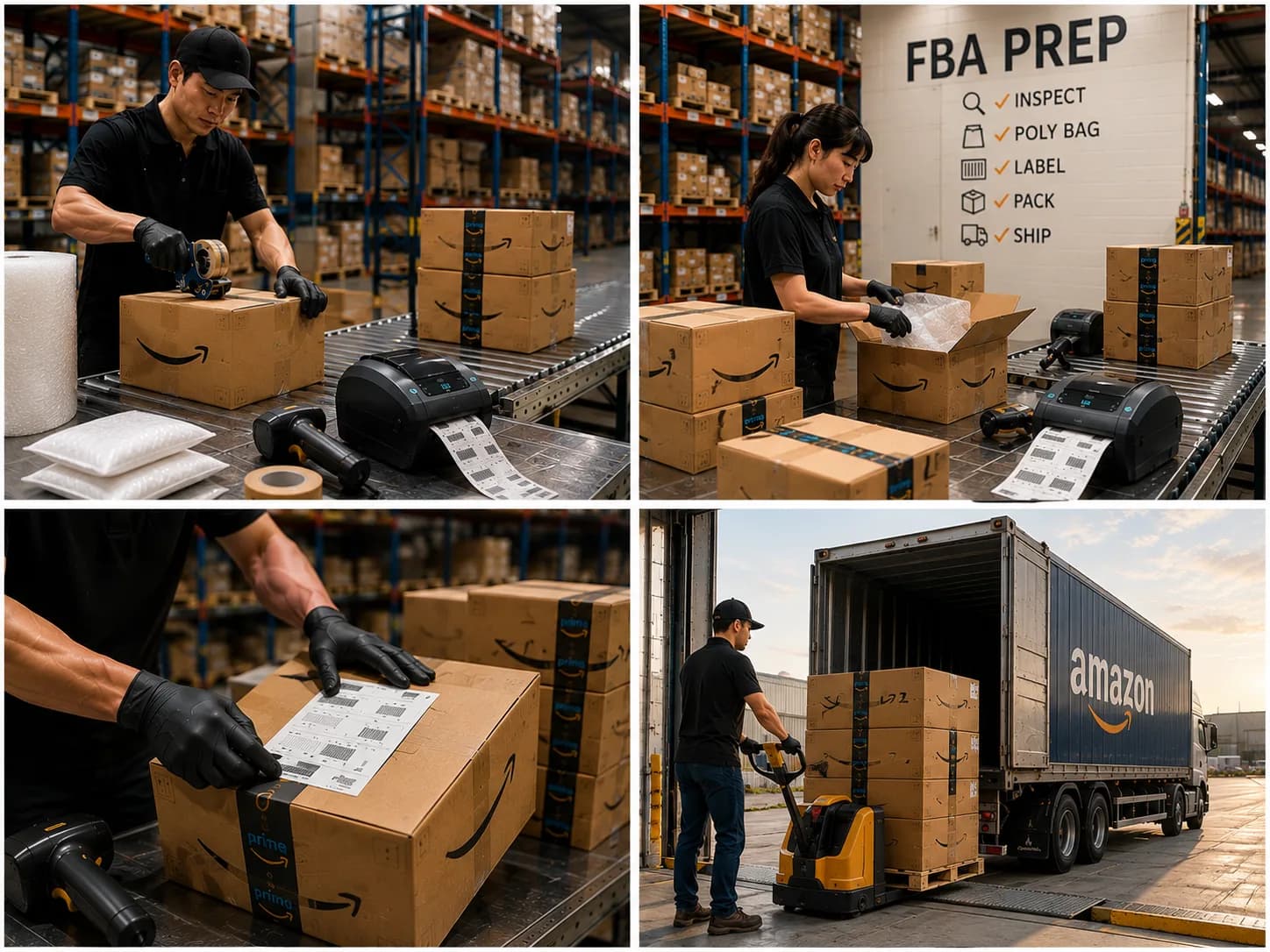
Yes, for merchant-fulfilled orders shipped from our warehouse to the buyer. If you're sending inventory into Amazon's own network instead, that's prep work — see our Amazon FBA prep services page.
Yes. TikTok Shop orders are fulfilled and shipped like any other channel's, with tracking returned so the order is marked shipped within the platform's window. We are not a TikTok-certified or officially partnered provider and don't claim to be.
Yes. Stock is tracked by SKU and location, with on-hand, allocated and available counts visible to you, so you can reorder before a listing runs out rather than after.
Yes — returns are received against the original order, inspected and dispositioned to restock, quarantine or disposal by your rules, with the reason reported. Not every returned item can be resold, and we report those as they are.
Yes. We'll pack in your branded boxes, mailers, tissue and inserts where you supply them, or in standard materials where you'd rather not carry the cost.
Orders received before our daily cutoff are processed the same business day when the stock is on hand; we'll confirm the exact cutoff for your account. Transit time after that is the carrier's, not ours.
In Southern California, through partner warehouses in the Los Angeles, Ontario and Riverside corridor — near the ports for imported inventory and in the nearest ground zones for California and the western states.
It depends on your order profile — orders per month, units per order, SKU count, storage and shipping lanes. The 3PL pricing page explains how each charge is built up, and the cost calculator gives an estimate from your own numbers.
Start a quote
Tell us roughly how much you ship and we'll quote ecommerce fulfillment on the published rates — the same ones on the pricing page.
Picking a range just pre-fills the form — you can change it there, and the published rates are the same whichever range you fall in.
Where to go next
3PL fulfillment services
The parent service: storage, pick and pack, multi-channel orders and returns.
3PL pricing
How receiving, storage, pick-pack and shipping charges are built up.
DTC fulfillment
The brand-experience side: branded unboxing, inserts and subscription boxes.
Retail fulfillment
When the same catalog starts shipping into retail DCs and stores.
Warehouse storage services
Bulk storage for inventory that isn't shipping this month.