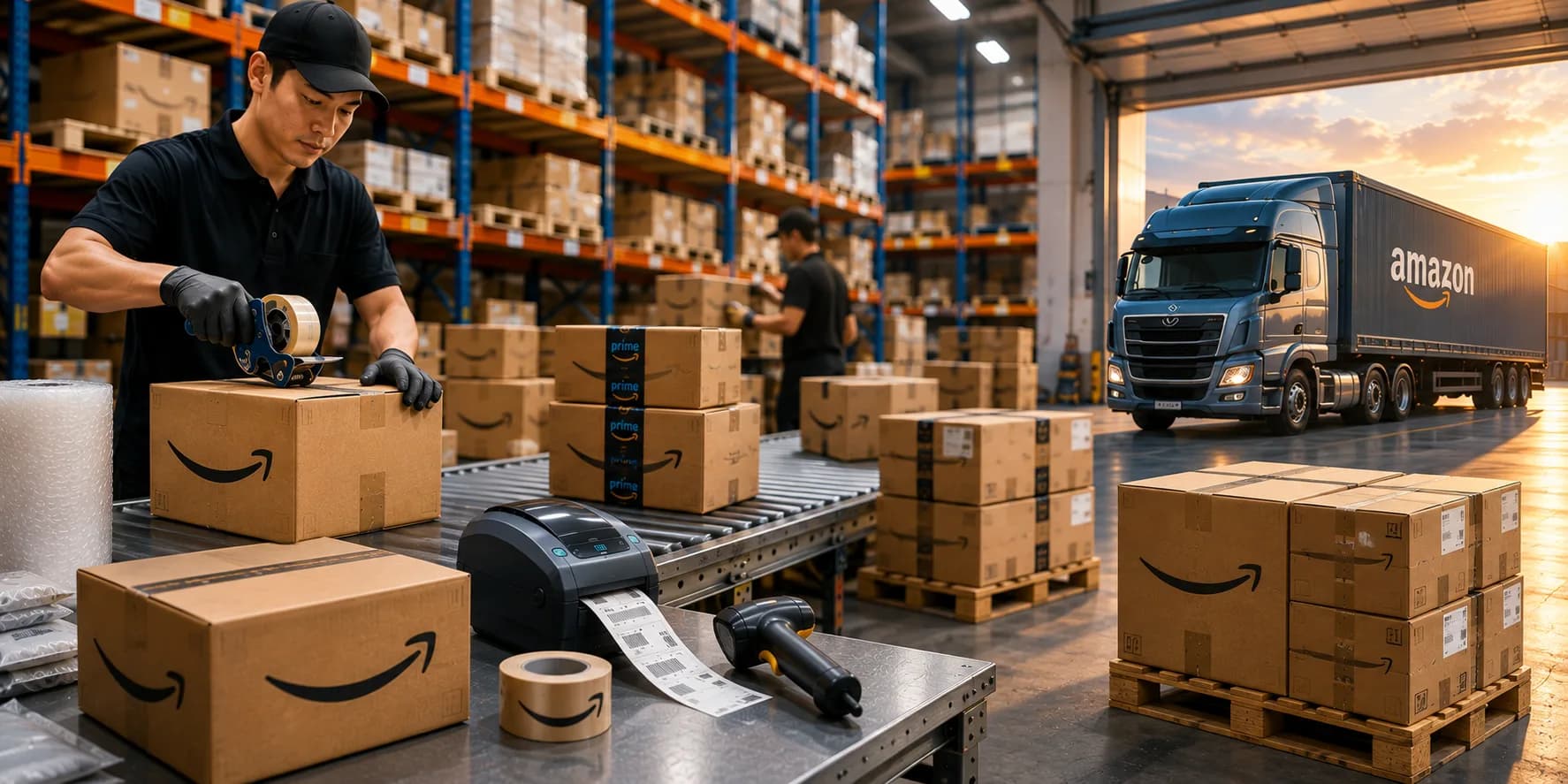
Amazon FBA Prep Services
Receiving, inspection, FNSKU labeling, poly bagging, bundling and carton prep for Amazon sellers — then forwarded to the fulfillment centers Amazon assigns, from Southern California.
- Receiving & inspection
- FNSKU labels, poly bags & bundles
- Forwarded to the FCs Amazon assigns
- LA · Ontario · Riverside
- Receiving
- Inspection
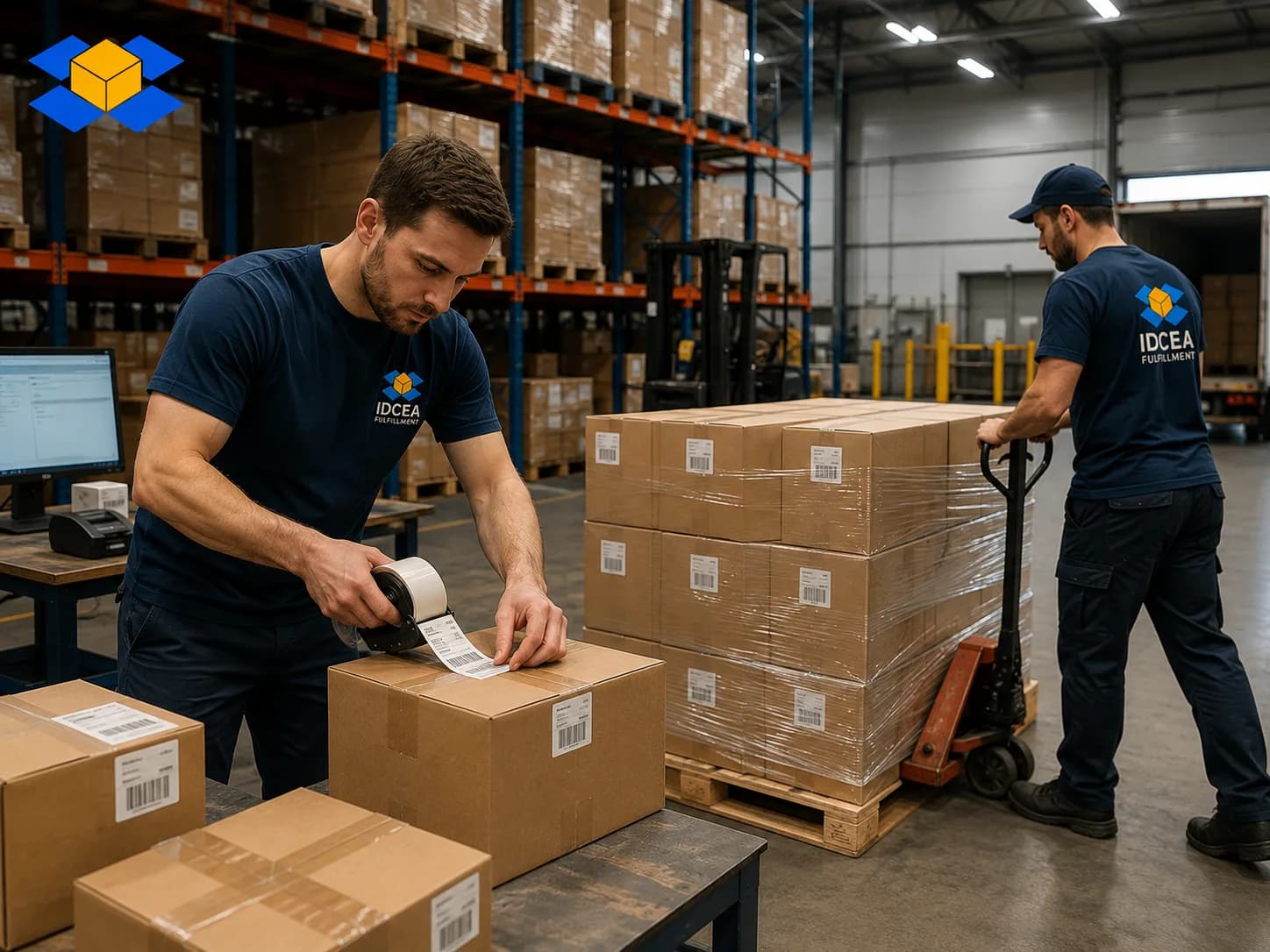
- FNSKU labeling
- Poly bagging
- Bundling
- Carton prep
What has to happen before inventory ships to Amazon
Inventory almost never arrives ready for Amazon. Cases from a manufacturer or supplier usually need FNSKU labeling, poly bagging, bundling or protective packaging before a fulfillment center will receive them — and whatever gets missed comes back as a refused shipment, a per-unit fee charged at the FC, or stock stranded during your best selling week.
IDCEA provides Amazon FBA prep services in California for exactly that gap. We receive your inventory, inspect and count it, prepare units to the Amazon requirements that apply to your products, pack and label cartons, then forward the shipment to the fulfillment centers Amazon assigns. Think of it as the operational step between your supplier and Amazon FBA.
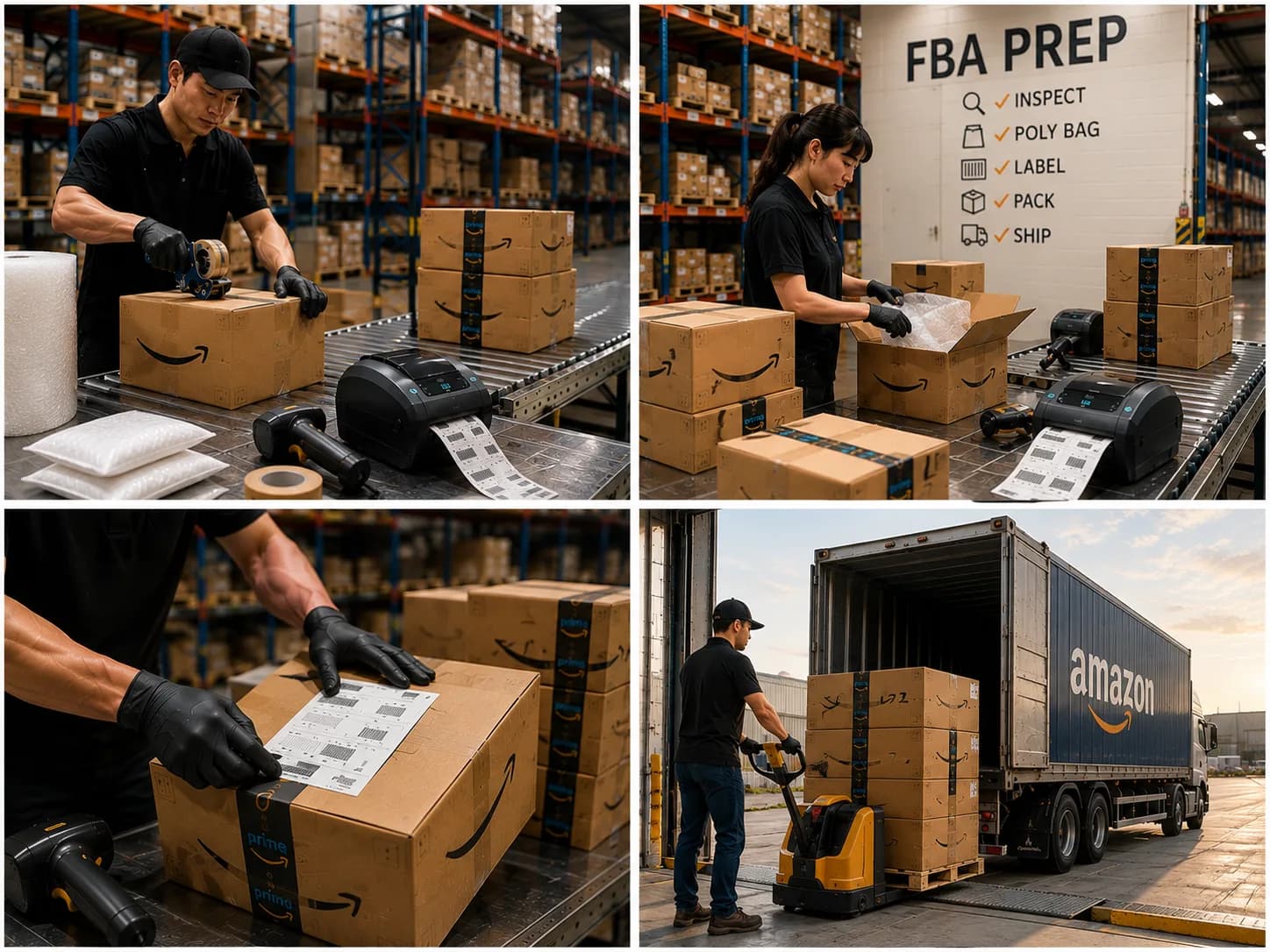
Amazon FBA Prep Services We Provide
FNSKU Labeling
Our FNSKU labeling service applies each unit's Amazon FNSKU over the manufacturer barcode, so the item scans as your listing instead of merging into someone else's. Scannable placement, one label per unit, checked as it goes.
Poly Bagging
FBA poly bagging for loose, soft or multi-piece items, with the suffocation warning printed on bags at or above the size Amazon requires it, and barcodes left scannable through the bag.
Product Inspection
Amazon product inspection on receipt: we verify quantities against your packing list, check for visible damage or short-shipping, and tell you what we found before anything is prepped or forwarded.
Bundling & Kitting
FBA bundling and kitting services that assemble multiple pieces into one sellable unit — multi-packs, variety sets and gift bundles — labeled and packaged as a single FNSKU.
Protective Packaging
Bubble wrap, dunnage and box-in-box protection for fragile, liquid or awkward items, so units survive FC handling rather than arriving as damage claims.
Expiry Dating & FIFO
Date labeling and FIFO handling for consumables and anything with a shelf life, following the expiration-date format Amazon requires for those categories.
Carton Preparation
FBA shipment prep at the carton level: unit counts, box content information, carton labels and weights recorded so cartons check in cleanly at FC receiving.
FBA Shipment Forwarding
FBA carton forwarding on your schedule to the fulfillment centers Amazon assigns for the shipment, with tracking handed straight back to you.
How Our Amazon FBA Prep Process Works
Receive
Your inventory arrives from your supplier, freight forwarder or another warehouse and is checked in against the shipment.
Inspect
We count units, compare them to your packing list and flag visible damage or shortages before any prep work starts.
Prep to spec
FNSKU labeling, poly bagging, bundling and protective packaging, following the Amazon requirements that apply to your products.
Pack cartons
Units are boxed with carton labels, box content information and recorded weights for FC receiving.
Forward to FBA
Cartons ship to the fulfillment centers Amazon assigns, on your schedule, and tracking comes back to you.
Amazon FBA Prep Center in Southern California
IDCEA runs FBA prep in Southern California through partner warehouses in the Los Angeles, Ontario and Riverside corridor. We coordinate and staff the prep work; we do not own the buildings, and we would rather say so than imply a facility we do not operate.
For sellers importing through the Los Angeles and Long Beach ports, that location keeps prep on the same side of the country as the container: goods clear the port, come to prep, and go out to Amazon without crossing the map first. The Inland Empire also sits on the I-10 and I-15 corridors, so outbound cartons reach carriers on regular schedules.
The corridor
- Los Angeles
- Closest to the LA / Long Beach port complex.
- Ontario
- Inland Empire, on the I-10 and I-15 freight corridors.
- Riverside
- Inland Empire, for space and outbound lanes.
FBA Prep for Imported Inventory
If you import — from China or anywhere else — your goods can come straight to us instead of to your own space. The flow is: manufacturer or supplier → IDCEA receives and inspects → FBA prep → the Amazon fulfillment center. You never touch the freight.
Your freight forwarder and customs broker still handle the import itself; we are not a customs broker and do not clear cargo. We take over once the goods are released and delivered to us, which is the point where labeling, bagging and carton prep actually have to happen.
- STEP 1Supplier ships
- STEP 2Forwarder & broker clear it
- STEP 3IDCEA receives & inspects
- STEP 4FBA prep
- STEP 5Forwarded to Amazon
FBA Prep for Amazon Sellers and Growing Brands
The sellers who get the most out of a 3PL for Amazon prep are the ones whose volume has outgrown a garage but does not justify hiring for it:
Why Amazon sellers use IDCEA for FBA prep
Prepped to current requirements
We work to Amazon's published prep and labeling requirements for your product types, and flag anything that looks likely to be refused.Prep next to the ports
Imported inventory is prepped in Southern California instead of crossing the country first.Per-unit pricing
Predictable prep costs replace unpredictable labor and rework.What you pay for — and what you don't
Billed per activity
- Pick & pack — first item per order, plus each additional item
- Storage — from day 8, by cubic metre and inventory age
- Receiving — per carton or per container
- Returns — per package received, inspection per unit
- Packaging materials — billed on the materials used
- Carrier postage — at the applicable carrier rate
Not billed
- Setup fee
- Monthly minimum
- Basic WMS / OMS access
- Storage for the first 7 days
Three steps to get started
Check the starting rates
See what pick and pack starts at and what drives the rest of the invoice, so you know what to send us.View 3PL pricing →Request a quote
Tell us your SKUs, channels and any special handling, and we'll confirm how the work runs and what it costs for your account.Request a quote →Send your inventory
Ship your first inbound to the Southern California partner warehouse we assign; it's received and counted against your paperwork before any work starts.Common questions
It is the work that has to happen between your supplier and Amazon: receiving the inventory, inspecting it, labeling each unit with its FNSKU, poly bagging or bundling where required, packing cartons and forwarding them to the fulfillment centers Amazon assigns.
Nothing you could not do — it is a question of volume and rework. A prep center absorbs the labeling, bagging and carton work at per-unit cost, catches problems while they are still cheap to fix, and does not need you to rent space for a container of stock.
Yes. We apply FNSKU labels over the manufacturer barcode so each unit scans as your listing, and check placement and scannability as part of the prep.
Yes. We poly bag loose, soft and multi-piece items, use bags with the suffocation warning where the bag size requires it, and keep barcodes scannable through the bag.
Yes. We assemble multi-packs, variety sets and gift bundles into a single sellable unit and label it with one FNSKU.
Yes. Most of our prep volume arrives straight from a manufacturer, supplier or freight forwarder — you do not need to receive it yourself first.
Yes. Your freight forwarder or customs broker handles the import and clearance; we take over once the goods are released and delivered to us.
In Southern California, through partner warehouses in the Los Angeles, Ontario and Riverside corridor — close to the Los Angeles and Long Beach ports for imported inventory.
Typical receipts are prepped within 24–48 hours. We confirm the timeline for your volume and product type before you ship, since large or complex prep can take longer.
Yes. We verify quantities against your packing list and check for visible damage or short-shipping, and we report what we find before forwarding anything.
Yes. We can hold stock and release it to FBA in batches, which is the usual way to manage Amazon's inventory limits and long-term storage fees.
Both, plus importers and multi-channel brands. Private-label runs and wholesale case-pack buys need different prep, and we quote them separately.
Yes — we can store and ship FBM orders directly, including Seller-Fulfilled Prime fulfillment.
We apply date labels in the format Amazon requires for those categories and use FIFO handling for consumables and dated goods.
Start a quote
Tell us roughly how much you ship and we'll quote amazon fba prep on the published rates — the same ones on the pricing page.
Picking a range just pre-fills the form — you can change it there, and the published rates are the same whichever range you fall in.
Where to go next
3PL fulfillment services
The full picture: storage, pick and pack, multi-channel orders and returns.
3PL pricing
How receiving, storage, pick-pack and shipping charges are actually built up.
Warehouse storage services
Hold inventory and release it to Amazon in batches instead of all at once.
Ecommerce fulfillment
For the orders you ship yourself, off your own store and other marketplaces.