Amazon FBA Warehouse in California: Choosing Where Your Inventory Gets Prepped Before Amazon
An "Amazon FBA warehouse" for a seller is the prep and staging location in front of Amazon's fulfillment centers. Why sellers stage it in Southern California, how port basin and Inland Empire locations compare, and what to ask before you send a container.
Search for an "Amazon FBA warehouse in California" and you get two very different kinds of building mixed together. One is Amazon's own fulfillment centers, which you cannot rent, visit or choose. The other is the warehouse that sits in front of them: the prep and staging location where your inventory is received, inspected, labeled and packed into cartons before Amazon ever sees it. This article is about the second kind, and about what to check when you pick one in California.
What an "Amazon FBA warehouse" actually means for a seller
Amazon decides which of its fulfillment centers receives a given shipment. When you create an inbound plan, Amazon assigns the destinations, and that assignment can split one purchase order across several sites. So the location decision a seller really makes is not "which Amazon building" but "where does my inventory get made Amazon-ready".
That location does four jobs:
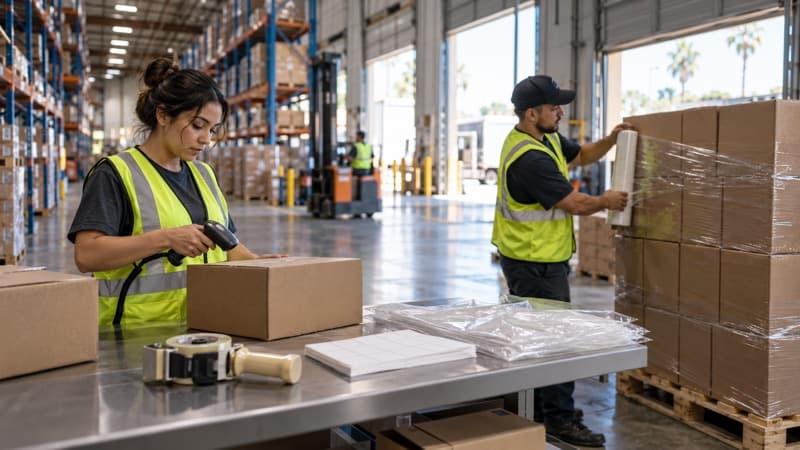
- Receiving. Freight from a supplier, forwarder or another warehouse is docked and checked in against the shipment.
- Inspection. Units are counted against the packing list and checked for visible damage or short-shipping before any labor is spent on them.
- Prep. FNSKU labeling, poly bagging, bundling and protective packaging, following the Amazon requirements that apply to the product type.
- Staging and forwarding. Cartons are packed with box content information, labeled, weighed and sent to the fulfillment centers Amazon assigns.
If you want the full list of prep tasks and how they are priced, our Amazon FBA Prep Services: A Complete Guide for Sellers walks through each one.

Why so many sellers stage FBA inventory in California
For brands that manufacture overseas, Southern California is where a large share of the freight lands. Containers arrive through the Los Angeles and Long Beach ports, and the question becomes how far that inventory travels before it is prepped.
Prepping near the port keeps the work on the same side of the country as the container. Goods clear the port, come to a prep warehouse, and go out to Amazon without a cross-country leg first and a second leg back. The Inland Empire, east of Los Angeles, also sits on the I-10 and I-15 freight corridors, so outbound cartons reach carriers on regular schedules.
The flow for imported inventory usually looks like this:
- The supplier ships.
- Your freight forwarder and customs broker handle the import and clearance.
- The prep warehouse receives the released goods and inspects them.
- Units are prepped and packed into cartons.
- Cartons are forwarded to the Amazon fulfillment centers assigned in your inbound plan.
Step 2 matters when you compare providers. A prep warehouse is not a customs broker, and a good one will say so. The handoff point is when goods are released and delivered to the dock. Our article on how imported container freight becomes an Amazon shipment covers that handoff in more detail.
Port basin or Inland Empire?
Within Southern California the choice is mostly between being close to the ports and being out on the freight corridors.
| Location | Strength | Trade-off to ask about |
|---|---|---|
| Los Angeles (port basin) | Shortest dray from the Los Angeles / Long Beach port complex | Space tends to be tighter; confirm storage capacity for buffer stock |
| Ontario (Inland Empire) | On the I-10 and I-15 corridors for outbound freight | A longer dray from the port than a basin location |
| Riverside (Inland Empire) | Space and outbound lanes | Same as above; ask how inbound containers are scheduled |
For most FBA sellers the difference between these is smaller than the difference between a prep operation that inspects carefully and one that does not. Pick the area that suits your freight, then judge the operation itself.

What to check before you send a container
Ask every California FBA warehouse you are considering the same questions:
- Do you inspect before you prep? A count against the packing list and a damage check, reported back before anything is forwarded, is where short-shipped or damaged units get caught while they are still cheap to fix.
- Which prep tasks do you do in-house? FNSKU labeling over the manufacturer barcode, poly bagging with the correct suffocation warning, bundling and kitting into a single FNSKU, and expiration-date labeling for dated goods.
- Can you hold inventory and release it in batches? Amazon's storage and restock limits often mean a container cannot go into FBA all at once. A warehouse that can store and release on your schedule acts as a buffer; our piece on using a 3PL buffer when Amazon caps your inventory explains how that works.
- How do you handle carton-level data? Unit counts, box content information, carton labels and weights should be recorded so cartons check in cleanly at the fulfillment center.
- Can you ship orders yourselves too? If you sell off your own store or other marketplaces, or run FBM alongside FBA, one inventory pool in one place is simpler than two.
- Who owns the building? Many providers work through partner facilities. That is normal; what matters is that they say so plainly and that you know who is running the floor.
How IDCEA handles FBA prep in California
IDCEA runs FBA prep through partner warehouses in the Los Angeles, Ontario and Riverside corridor. We coordinate and staff the prep work; we do not own the buildings. Inventory can come straight from your supplier or freight forwarder, and we receive it, inspect it against your packing list, prep it to Amazon's published requirements for your product type and forward cartons to the fulfillment centers Amazon assigns. We can also store stock and release it to FBA in batches.
If you are deciding where your FBA inventory should be staged, the Amazon FBA prep service page sets out what we handle and how the process runs.