
Distribution Center Fulfillment: Running Wholesale Pallets and Online Parcels From One Building
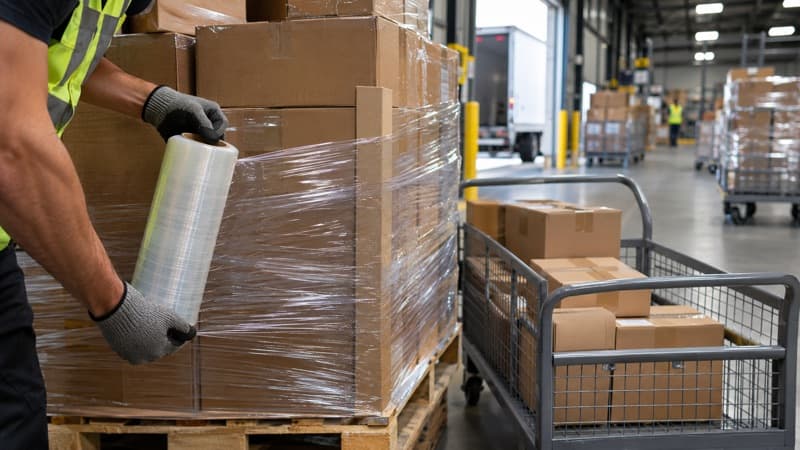
One building, one inventory count, two very different workflows. How a distribution center ships wholesale cases and pallets alongside online parcel orders without one starving the other.
Distribution center fulfillment means one building handles every way your product leaves: full pallets to a distributor, mixed cases to a boutique, and single parcels to online customers, all from the same inventory. For brands that sell both wholesale and direct, it replaces the common setup of one warehouse for pallets and a separate fulfillment center for parcels — and the stock transfers, double counts and timing gaps that come with it.
The trade-off is that one building now has to run two very different workflows without letting one starve the other. Here is how that works in practice.
Two order types, one stock pool
Wholesale and ecommerce orders look nothing alike on the warehouse floor:
| Wholesale / B2B order | Ecommerce / DTC order | |
|---|---|---|
| Typical size | Cases or full pallets | One to a few units |
| Pick method | Case or pallet pick from reserve | Each pick from forward locations |
| Paperwork | Purchase order, packing list, bill of lading | Packing slip, carrier label |
| Ship method | LTL or FTL freight, sometimes small parcel for small orders | Small parcel |
| Deadline | Ship window on the purchase order | Daily carrier cutoff |
The building's job is to serve both from a single, accurate count. That only works if the warehouse management system (WMS) knows the difference between units sitting in reserve as full cases and units broken out into pick faces for parcel orders.
How the inventory is laid out
Most distribution center setups split each SKU into two zones:
- Reserve storage — full pallets and sealed master cartons in racking. Wholesale orders pick straight from here, ideally in full-case quantities so cartons never get opened.
- Forward pick locations — a smaller quantity of each SKU broken down into shelves or bins near the packing stations. Parcel orders pick from here.
Replenishment moves stock from reserve to forward as the pick faces drain. Both zones belong to the same SKU count, so a channel never sees "out of stock" just because the units are on a pallet upstairs.

Allocation: deciding who gets stock when it's short
The hardest moment in a mixed building is when a large purchase order and a weekend of online orders both want the same units. Decide the rule before it happens:
- Reserve a quantity for each channel so a single big PO can't wipe out online availability.
- Ship-complete or partial? Many retail and wholesale buyers have a fill-rate expectation; some accept partial shipments, some don't. See Partial Shipments and Fill Rate: Ship-Complete Rules for Wholesale Purchase Orders for how those rules play out.
- Who approves an override — someone on your side, not the warehouse, should decide whether to short a store or pause a web promotion.
Keeping the two workflows from colliding
Freight orders and parcel orders compete for dock space, labor and staging lanes. A building that handles both well usually:
- Runs parcel packing on a fixed daily rhythm tied to carrier pickups.
- Stages wholesale pallets in their own lane so they are built, wrapped and checked before the truck arrives.
- Builds pallets to the carrier's and receiving dock's limits — our guide to LTL Pallet Height and Weight Limits covers what gets rejected and why.
- Keeps case-pack data (units per inner, inners per master) in the item record so wholesale picks don't need a calculator.
Small wholesale accounts sit in the middle
Not every B2B order is a pallet. Independent shops often order a few cases at a time — too big to treat as a parcel order, too small for freight. A distribution center handles these as case picks shipped by small parcel or a consolidated LTL run. The workflow for those smaller accounts is covered in Small-Retailer Wholesale Orders: Fulfilling Boutique Opening Orders and Reorders Through a 3PL.
When one building is the right answer
Distribution center fulfillment fits best when:
- You sell the same SKUs both wholesale and online.
- Your wholesale volume is large enough to need freight, but not so large that it needs its own building.
- You want one inventory count and one monthly bill rather than reconciling two warehouses.
It fits less well if your wholesale business needs specialized handling the parcel side doesn't — temperature control, for example — or if one channel is so dominant that the other would always be squeezed.
How IDCEA handles it
IDCEA's B2B and wholesale fulfillment runs purchase orders, case and pallet shipments, retailer routing guides and LTL or FTL freight from the same inventory that serves your online orders. Operations run through partner warehouses in the Los Angeles, Ontario and Riverside corridor in Southern California, close to the Los Angeles and Long Beach ports, and orders ship nationwide from there. Pricing for freight and storage is quoted on your order profile.