
EDI for Retail Orders: What the 850, 856 and 810 Actually Do in Fulfillment
Retail programs run on structured documents. Here is what the purchase order, advance ship notice and invoice each carry, which one drives chargebacks, and what has to be true in the warehouse for them to be accurate.
Your first retail program does not arrive as a spreadsheet. It arrives as a stream of structured documents that a buyer's system sends to yours, and the warehouse is expected to answer in the same format, on the retailer's clock. Brands that have only ever shipped direct-to-consumer are often surprised by how much of retail fulfillment is document work rather than picking work.
Three transaction sets carry most of that traffic: the 850, the 856 and the 810. Understanding what each one does — and which one tends to generate chargebacks — makes the difference between a program that renews and one that quietly gets cancelled.
The documents behind a single retail order
| Set | Name | Direction | What it carries |
|---|---|---|---|
| 850 | Purchase Order | Retailer to you | What to ship, how much, where, and the ship window |
| 855 | PO Acknowledgement | You to retailer | Confirmation, including line items you cannot fill |
| 856 | Advance Ship Notice | You to retailer | What is physically on the truck, nested by pallet and carton |
| 810 | Invoice | You to retailer | What to pay, matched against the 850 and the receipt |
| 997 | Functional Acknowledgement | Both ways | A receipt confirming the file arrived and parsed |
The 997 looks like noise until a file fails silently. It is the only proof that the other side received anything at all.
What the 850 tells the warehouse
The purchase order sets the constraints everything downstream inherits. Beyond the obvious line items and quantities, it carries the ship window — a start date and a cancel date — and the destination, which may be a regional distribution center rather than the address on the retailer's website.
Two fields cause most of the trouble. The first is the inner-pack or case-quantity specification: retailers order in cases, not eaches, and a warehouse that picks eaches against a case-quantity PO will build a shipment that gets refused at the door. The second is the ship window itself. Arriving early is a violation in the same way arriving late is, because the receiving dock has scheduled labor against that appointment.

The 856 is the one that gets you charged back
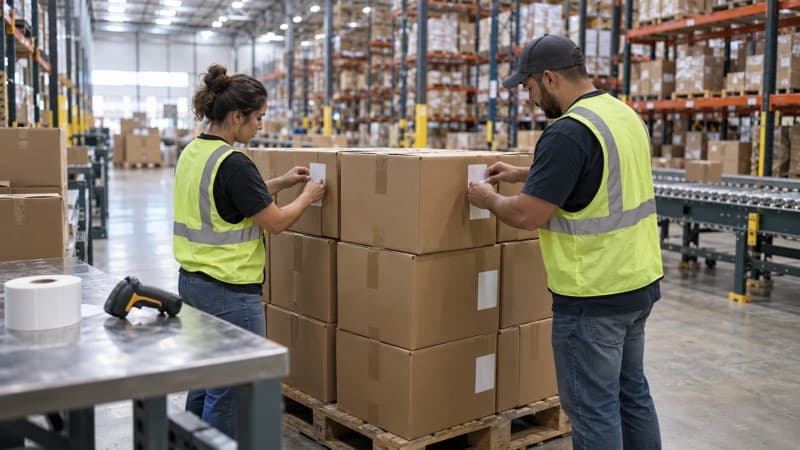
The advance ship notice is a map of the physical shipment. It describes the hierarchy — this pallet contains these cartons, this carton contains these SKUs in these quantities — and every carton in that hierarchy is identified by a serialized shipping label carrying a unique number.
When the retailer receives the truck, they scan the label on each carton and expect the contents to match what the ASN promised. Any divergence is measurable: a carton on the truck that is not on the ASN, a carton on the ASN that is not on the truck, a label that will not scan, a pallet built differently than described. These are exactly the discrepancies that retailer scorecards are built to count, and they are the mechanical reason so much of retail compliance is really about labeling discipline. The routing guide rules and chargeback structures sit on top of this document.
An accurate 856 is not a data problem that can be solved after the truck leaves. It has to be generated from what was actually packed, which means the pack process itself has to be scanned rather than counted by hand.
Where the 810 fits
The invoice is matched three ways: against the original 850, against the ASN, and against what the receiving dock actually counted. When those three disagree, the invoice goes into exception handling and payment stops until someone reconciles it.
This is why invoice accuracy is downstream of warehouse accuracy. A short shipment that nobody flagged becomes a payment dispute weeks later, usually at the point when the brand has already spent the money.
What has to be true in the warehouse
EDI is only the messaging layer. For the documents to be truthful, the operation underneath them has to support a few things:
- Case and pallet handling, because retail orders move as cases and pallets rather than as parcels — a different physical flow from ecommerce picking, as covered in how B2B orders move through the warehouse
- Serialized carton labeling applied at pack time and captured in the same transaction that builds the ASN
- Retailer-specific packing rules, including case quantities, ticketing, and any retail-ready packaging the program requires
- Appointment scheduling at the receiving DC, with enough lead time to hit the ship window rather than beat it
- An exception path for shorts and damages that produces a corrected document rather than a phone call
Questions worth asking before your first retail PO
Ask a prospective partner how the ASN is generated — from the pack scan, or typed afterward from a pick list. Ask which retailers they already transmit to and whether the mapping is per-retailer. Ask who owns the label format when a retailer updates its routing guide, and how quickly that change reaches the floor. Ask what happens when a line item cannot be filled: whether an acknowledgement goes back automatically, or the shortage is discovered at receiving.
IDCEA supports these programs through partner warehouses in Southern California, alongside our retail fulfillment operations. If you are evaluating whether your current setup can carry a retail program, the document flow above is a practical place to start the audit.