
FBA Packaging Service: Poly Bags, Bubble Wrap and the Carton Rules Amazon Checks
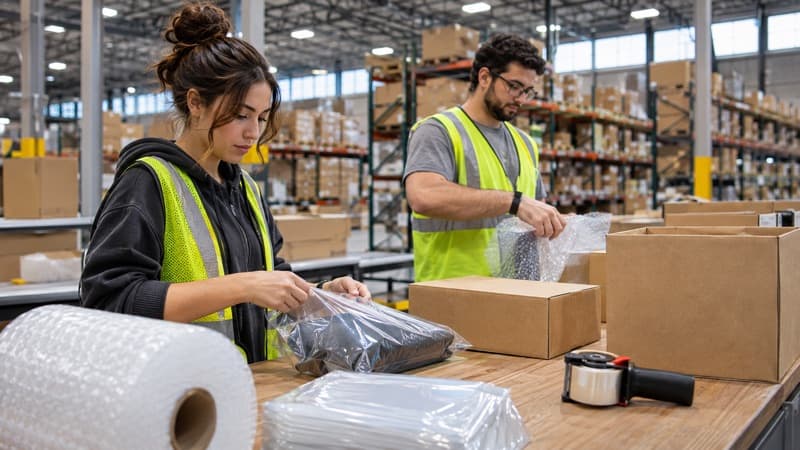
An FBA packaging service puts each unit into the packaging Amazon requires for its product type, then packs it into cartons that meet Amazon's size and weight limits. Here is what each product type needs and what to tell a prep center.
An FBA packaging service puts each unit into the packaging Amazon requires for its product type (poly bags, bubble wrap, boxes or sealed bags for liquids), then packs those units into cartons that meet Amazon's size and weight limits. Packaging decides whether a fulfillment center receives a unit as sellable, charges you to fix it, or sends it back.
Barcode placement has its own article: FNSKU Labeling: Barcode Rules, Label Placement and What a Prep Center Does.
Why packaging gets checked at FBA receiving
Amazon fulfillment centers are built for speed. Units are scanned, stowed in mixed bins next to unrelated products and picked by people who have never seen your item. Packaging that works on a store shelf often fails in that environment:
- Loose pieces separate from each other and get stowed as different items
- Unbagged textiles pick up dust and damage in the bin
- Glass and ceramics break when a tote is dropped onto a conveyor
- Liquids leak onto everything stowed beside them
Packaging that does not meet Amazon's requirements can mean prep fees charged at the fulfillment center, units that cannot be received, or stock held back until the problem is sorted out. Amazon updates these requirements, so check the current prep guidance in Seller Central for your category before a new product's first shipment.
Packaging requirements by product type
The table summarizes the common cases. Amazon's prep guidance has the full list.
| Product type | Typical packaging | What the packer checks |
|---|---|---|
| Apparel, textiles, plush | Clear poly bag | Bag sealed, barcode scannable through it |
| Loose multi-piece items | Poly bag or box | Pieces cannot separate |
| Glass, ceramics, fragile | Bubble wrap, box-in-box | Unit survives a drop without breaking |
| Liquids | Sealed caps, bagged if needed | No leak if the unit is tipped over |
| Sharp items | Blister pack or box | No exposed edges or points |
| Small items | Poly bag | Unit is not too small to scan and stow on its own |
| Sets sold as one unit | Bagged, boxed or shrink-wrapped together | Set cannot come apart, set label applied |
Poly bags
Poly bags are the most common FBA packaging. Amazon's guidance calls for transparent bags at least 1.5 mil thick, with a suffocation warning printed on or attached to any bag with an opening of 5 inches or more. The bag has to be fully sealed, and the unit's barcode must scan through it, or the FNSKU label goes on the outside of the bag.
Bubble wrap and boxing
Fragile units are wrapped so they survive normal handling. Amazon's guidance uses a 3-foot drop test as the benchmark. Bubble wrap has to cover the whole item and be taped so it cannot unwrap, and very fragile items are often boxed or put box-in-box with void fill. The more protection you add, the bigger the unit gets, and size affects storage and fulfillment fees. A good packer uses only as much protection as the item needs.

Sets and bundles
Anything sold as one unit has to stay together all the way through receiving and picking. For how multipacks are bagged and labeled as a single FNSKU, see FBA Bundles and Multipacks: Set Labels, Poly Bagging and Keeping Units Together Through Prep.
Carton rules on top of unit packaging
Once units are packaged, they go into shipping cartons, and Amazon has rules for those as well. Its current guidance includes:
- Size: standard cartons should not exceed 25 inches on any side, unless a single unit is larger than that.
- Weight: cartons should not exceed 50 lb, unless a single unit weighs more. Heavier single units need team-lift or mechanical-lift markings.
- Construction: a rigid six-sided box with its flaps intact. Reused boxes need old labels and markings removed or covered.
- Box content: unit counts per carton recorded accurately, so the shipment checks in against what you declared.
A service that bags units but leaves the cartons to you has done half the job.
What to send a prep center before the first shipment
A prep center can only package units the right way if it knows what the units are. Before your supplier ships, provide:
- The ASIN and FNSKU for every SKU, and whether the manufacturer barcode is eligible or each unit needs an FNSKU label
- Product type notes for anything fragile, liquid, sharp, textile or sold as a set
- Your packaging preference where Amazon allows more than one option, for example bag or box for a small item
- Any brand packaging rules, such as no stickers on the retail box or a specific bag size
- Expected quantities and the shipment plan, so cartons can be built to the right counts
A sample unit, or photos of a correctly packaged one, settles most questions before the full run.
Where IDCEA fits
IDCEA runs Amazon FBA prep services in Southern California through partner warehouses in the Los Angeles, Ontario and Riverside corridor. We staff and coordinate the prep work but do not own the buildings. Packaging is part of the same prep flow: we receive and inspect your inventory, poly bag, bubble wrap or bundle each unit to the Amazon requirements that apply to it, pack cartons with recorded counts and weights, and forward the shipment to the fulfillment centers Amazon assigns.
For sellers importing through the Los Angeles and Long Beach ports, that keeps packaging on the same side of the country as the container. Send us the SKU list and what each product is, and we will scope the packaging per SKU before anything is prepped.