
Palletizing Services: Stack Patterns, Stretch Wrap and Repalletizing at a 3PL
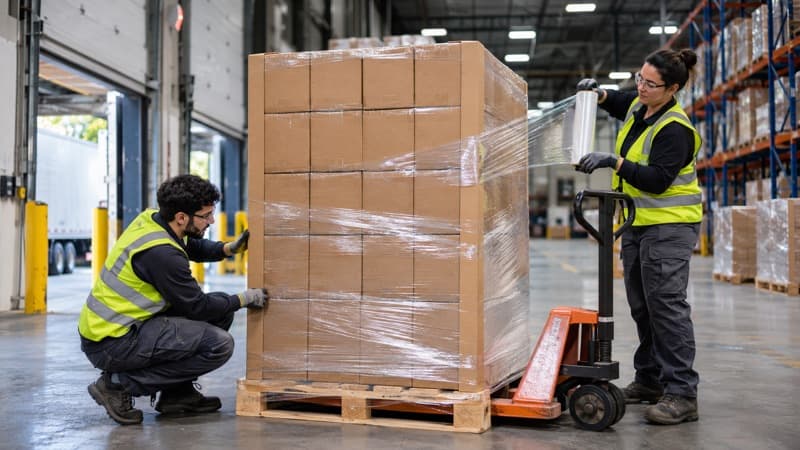
What palletizing services at a 3PL include — single-SKU and mixed pallet builds, column vs interlock stacking, wrap and corner boards, and repalletizing floor-loaded freight.
A wholesale order can be picked perfectly and still arrive as a problem: a leaning stack, crushed bottom cartons, a pallet the DC refuses because it is too tall or its labels face the wrong way. Palletizing is the step that decides whether a case-level order travels as one stable unit or as a pile of loose boxes on a deck.
What palletizing services include
Palletizing services are the work of turning cartons into a shippable unit load: choosing the pallet, stacking cartons in a set pattern, securing the stack and labeling it for the carrier and the receiver. At a 3PL it usually covers four jobs:
- Outbound pallet builds for wholesale and retail purchase orders, single-SKU or mixed.
- Repalletizing freight that arrived floor-loaded in a container or on damaged pallets.
- Rebuilding pallets that were broken down for a partial pick and now need to ship.
- Pallet labeling with the shipping and carton-level labels the buyer's routing guide asks for.
It sits between case picking and freight booking. Our walkthrough of how B2B orders move through the warehouse shows where pallet builds fit between the pick and the LTL pickup.
Single-SKU and mixed pallets
| Single-SKU pallet | Mixed pallet | |
|---|---|---|
| Contents | One SKU, identical cartons | Several SKUs, different carton sizes |
| Stack pattern | Repeating layer pattern | Heaviest and largest first |
| Main risk | Wrong pattern for the carton strength | Unstable top layers, crushed light cartons |
| Labeling | Often one label set per pallet | Pallet label plus carton labels |
Mixed pallets need more judgment: heavy, full-size cartons on the bottom, lighter ones on top, odd sizes grouped so each layer stays flat. Whether SKUs or stores must be kept on separate pallets is a routing-guide question, not a warehouse preference.
Stack patterns: column or interlock
A column stack places each carton directly on top of the one below, corner over corner. Corrugated cartons carry most of their load through their corners and walls, so column stacking keeps the most compression strength.
An interlocking stack rotates alternate layers so cartons bridge the seams below, like bricks. That ties the load together and resists sliding, but the cartons no longer sit corner on corner, so they carry less weight before the bottom layers start to crush.
In practice, a 3PL chooses per SKU — column for heavy cartons, interlock for light ones where stability matters more — and records cartons per layer and layers per pallet (tie and high) once, so every build of that item comes out the same. Overhang is the other rule: cartons hanging past the deck edge lose support and get crushed, so every carton stays inside the pallet footprint.
Securing and protecting the load
The finished stack has to stay a single unit through forklift moves, a truck ride and a cross-dock:
- Stretch wrap, started low so it anchors the stack to the pallet itself, not just the cartons to each other.
- Corner boards on the vertical edges to spread the wrap's pressure and protect corners from forks.
- A top sheet or cap to keep dust and water off the top layer and help hold it square.
- Slip sheets between layers when cartons are slick or layers need to stay flat.
- Banding or strapping for very heavy or dense loads, where wrap alone will not hold.

How tall and how heavy the finished pallet can be depends on the carrier and the receiving DC, not just on what the stack can bear. Our guide to LTL pallet height and weight limits covers those limits and how they change the build.
Repalletizing floor-loaded and damaged freight
Much palletizing happens on the inbound side. Imported goods often arrive floor-loaded, stacked straight on the container floor, and have to be built onto pallets by hand before they can go into racking or ship onward.

Repalletizing is also how damaged inbound pallets get fixed: a broken deck board, a collapsed corner or a stack that shifted in transit is rebuilt onto a sound pallet, and any crushed cartons are set aside and reported rather than buried in the middle of a new stack.
Retail pallets and display-ready builds
Retail buyers often add requirements on top of a sound build — a set pallet type, a maximum height, labels on two adjacent sides — and some ask for pallets that roll straight onto the sales floor. Our article on Shipper Displays and Display-Ready Pallets: How Club and Big-Box Orders Get Built at a 3PL covers that more specialized build.
What to give your 3PL before the first build
Pallets come out consistent when decisions are written down once:
- Carton specs per SKU — dimensions, weight and units per carton.
- A pallet configuration per SKU — cartons per layer, layers per pallet and stack pattern.
- The buyer's routing guide — pallet type, height and weight caps, label placement and any contents-list rules.
- Wrap and protection rules — corner boards, top caps or banding for products that need them.
- What to do with partial pallets — ship mixed, ship short or hold for the next order.
Palletizing for B2B orders in Southern California
IDCEA builds pallets as part of its B2B fulfillment services: case and pallet picking, buyer-specific carton labels, palletizing and shrink-wrap to the account's pattern and height rules, then LTL or FTL booking. The work runs through partner warehouses in the Los Angeles, Ontario and Riverside corridor, close to the Los Angeles and Long Beach ports for imported freight that needs repalletizing, and on the I-10 and I-15 corridors for outbound pallets heading to carriers and retail DCs.