Retail Logistics Fulfillment: The Chain From Purchase Order to Retailer Dock
Retail logistics fulfillment step by step: purchase order intake, preparing goods to the retailer's spec, ASNs, routed freight and appointments, and who controls each handoff.
Retail logistics fulfillment is the chain of work that gets a brand's inventory from its warehouse onto a retailer's receiving dock: taking the purchase order, preparing goods to the retailer's specifications, shipping them through the retailer's freight rules and confirming delivery. It is fulfillment where the customer is a business with its own receiving system, not a shopper with a doorbell.
Each step has a different owner. The brand owns the relationship and the PO. The 3PL owns preparation and the dock. The retailer, through its routing guide and often its own carrier program, owns much of the freight. Most retail problems happen at the handoffs between them.
The retail logistics chain, step by step
- Purchase order in. The retailer issues a PO by EDI (an 850) or through a vendor portal. It sets quantities, pack sizes, a ship window and a cancel date.
- Order validation. The warehouse checks the PO against available stock and the routing guide before picking. Shortfalls are raised now, not discovered at the dock.
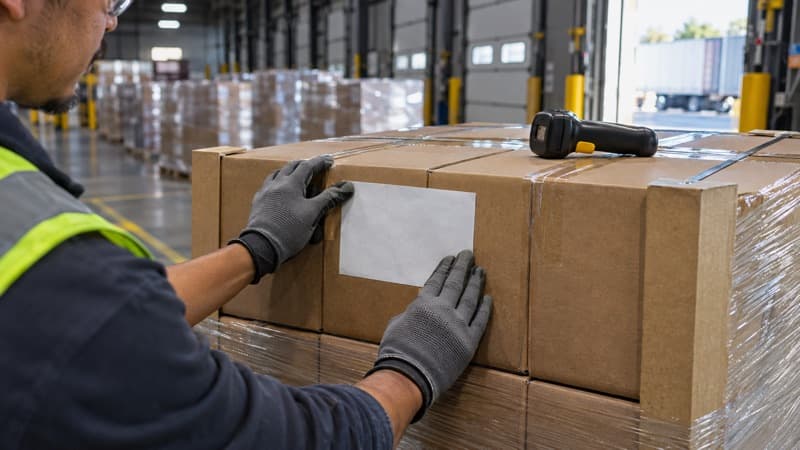
- Preparation. Cases and inner packs are built to the retailer's spec; price tickets, hangtags or item labels are applied where required; cartons get compliant labels.
- Pallet build and staging. Pallets are built to the retailer's height and pattern rules, wrapped, labeled and staged by destination.
- Shipment notice. An ASN (an 856) tells the retailer exactly what is coming, carton by carton.
- Freight and appointment. The load is tendered to the retailer's routing carrier or the shipper's carrier, and a delivery appointment is booked at the DC.
- Receipt and reconciliation. The retailer scans in the shipment against the ASN. Mismatches show up later as deductions.
Who controls what

| Decision | Usually controlled by |
|---|---|
| What ships, when, and in what pack size | Retailer, through the PO |
| How cartons, tickets and pallets are prepared | Retailer's routing guide; carried out by the 3PL |
| Which carrier moves the freight | Retailer on routed or collect programs; otherwise the shipper |
| Delivery appointment | Retailer's DC scheduling system |
| Whether the shipment "complied" | Retailer, after receiving |
That last line is why retail fulfillment is front-loaded. The retailer judges compliance after the freight arrives, and penalties come back as chargebacks deducted from payment. Retail Routing Guides and Chargebacks goes through the rules that most often trigger them.
Where retail freight actually goes
Retail logistics fulfillment does not always end at one big distribution center. The common destinations are:
- Retailer DCs. The most common. Cases are consolidated onto pallets and delivered by appointment; the retailer splits them out to stores.
- Direct to store. Smaller retailers, and some programs at larger ones, want cartons delivered to each store, which multiplies labels, ASNs and shipments. Direct-to-Store or DC Delivery compares the two.
- Drop-ship to the retailer's customers. Some retailers sell online and pass the order back to the vendor to ship in the retailer's name, which is retail logistics that looks like parcel fulfillment.
Many brands run all three for different accounts at the same time, which is why each account's rules have to be stored and applied per order rather than remembered.
How retail logistics differs from DTC fulfillment
| DTC fulfillment | Retail logistics fulfillment | |
|---|---|---|
| Order | Website or marketplace order | Purchase order with ship and cancel dates |
| Unit picked | Each | Case, inner pack or pallet |
| Rules set by | The carrier | The retailer's routing guide |
| Shipping | Parcel | LTL, FTL or routed carrier, by appointment |
| Errors show up as | A customer complaint | A refused load or a chargeback |
The same inventory can serve both, but the work on the floor is different. Retail work is mostly preparation and paperwork; DTC is mostly speed of pick and pack.
When the inventory arrives through Southern California
For brands importing through the Los Angeles and Long Beach ports, retail logistics often starts with a container rather than a finished pallet: goods are received, broken down by SKU, prepared for retail and shipped to DCs around the region and beyond. Retail Distribution in California: Moving Retailer Purchase Orders From the Port to the DC Dock covers that port-to-DC leg in more detail.
Where IDCEA fits
IDCEA's retail fulfillment service runs the preparation side of this chain: each account's routing guide captured once and applied on every order, EDI purchase-order intake and ASN transmission, UCC-128 and GS1 carton labels, price tickets and hangtags, case and inner packs to spec, pallets built to the guide, and appointments booked for DC or direct-to-store delivery.
It runs through partner warehouses in the Los Angeles, Ontario and Riverside corridor. IDCEA staffs and coordinates the work; we do not own the buildings. If you are opening your first retail account, the most useful thing to send is the retailer's routing guide, since it determines most of what the work involves.