
Ecommerce Fulfilment in the U.S. for Overseas Brands: Importing Stock, Holding It in California and Shipping Domestic Orders
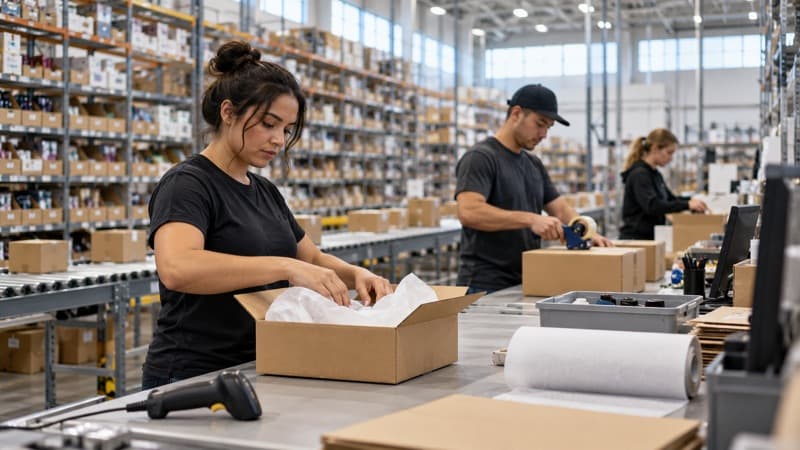
How overseas ecommerce brands move fulfilment into the U.S.: who handles freight, customs and the warehouse, how to prepare the first inbound, and how domestic orders ship once stock lands.
If you sell online from the UK, Europe or Australia and your U.S. orders are growing, ecommerce fulfilment in the U.S. usually means one thing: stop shipping each order across an ocean and hold stock in an American warehouse instead. A U.S. third-party logistics (3PL) partner receives your imported inventory, stores it by SKU, and picks, packs and ships each order as a domestic parcel.
That sounds simple, and the order-by-order work is the same as any ecommerce operation. What is different for an overseas brand is everything that happens before the first order ships — and who is responsible for each piece.

Why overseas brands move fulfilment into the U.S.
Shipping every order internationally works while volumes are small. As they grow, the trade-offs pile up:
- Delivery experience. U.S. shoppers compare you to domestic sellers. An international parcel with a long transit and a customs step is a hard sell next to a domestic one.
- Per-order cost. Moving inventory in bulk — by container or palletized freight — and then shipping short domestic hops is often cheaper per unit than paying for an international parcel on every order. Run the numbers on your own lanes before assuming it.
- Returns. A U.S. return that has to travel back overseas is rarely worth processing. A return that comes back to a U.S. warehouse can be inspected and put back into stock.
- Marketplace expectations. U.S. marketplaces score sellers on shipping speed and tracking. Domestic inventory makes those metrics far easier to meet.
Who does what: brand, forwarder, broker and 3PL
The most common confusion for overseas brands is assuming the fulfilment warehouse handles the whole journey. It usually doesn't. A typical split looks like this:
| Step | Usually handled by |
|---|---|
| Booking ocean or air freight from your factory | Your freight forwarder |
| U.S. customs clearance and import paperwork | Your customs broker |
| Delivery from port or airport to the warehouse | Forwarder or a drayage carrier |
| Receiving, counting and storing the goods | The 3PL |
| Picking, packing and shipping each order | The 3PL |
| Returns inspection and restocking | The 3PL |
At IDCEA, for example, we receive goods once they have cleared customs and arrived at the warehouse; customs brokerage and international freight stay with your broker or forwarder, and we coordinate the delivery appointment with them. Knowing where that hand-off sits avoids the worst surprise: a container that has cleared but has nowhere booked to go.
Preparing your first U.S. inbound
The first shipment sets the tone for everything after it. Before it leaves the factory:
- Send item data first. Every SKU needs dimensions, weight, barcode and carton quantities in the warehouse system before the goods arrive. Our guide to SKU onboarding at a 3PL lists exactly what to send.
- Label master cartons clearly. Each carton should show the SKU and quantity so it can be counted without opening it.
- Share a packing list or ASN. The warehouse counts against it and reports shortages or damage, which is your evidence if the factory or carrier is at fault.
- Decide how stock will be held. Fast sellers go to pick locations; bulk and slower stock can sit on pallets in reserve storage and be moved forward as needed.
How U.S. orders flow once stock lands
Once inventory is received, a U.S. ecommerce fulfillment operation runs the same loop every day:
- Orders import automatically from your store and marketplaces — by direct integration where the platform offers one, by scheduled feed where it doesn't.
- Each order is picked and scan-verified, so the right SKU and quantity go in the box.
- The order is packed in a box sized to the contents, with your inserts or branded packaging if you supply them.
- A label is bought after comparing carrier services and rates for that order.
- Tracking is pushed back to your store so the buyer gets updates without you sending them.

For a team in another time zone, visibility matters more than usual: you won't be walking the warehouse floor. Look for a partner whose system shows stock, orders and charges directly — our article on 3PL Client Portals: The Inventory, Order and Billing Visibility a Warehouse System Should Give You covers what that view should include.
Where in the U.S. to hold stock
For brands importing by sea from Asia, the West Coast is the natural landing point. IDCEA runs ecommerce fulfilment through partner warehouses in the Los Angeles, Ontario and Riverside corridor in Southern California — close to the Los Angeles and Long Beach port complex for imported inventory, and on the I-10 and I-15 freight corridors for outbound. Brands shipping mostly from Europe may weigh an East Coast entry point instead; the right answer depends on where your goods come from and where your customers are.
A short checklist before you sign
- Confirm the hand-off point: who books delivery from the port, and who the warehouse expects to hear from.
- Ask how receiving discrepancies are reported, and how quickly stock becomes available to sell.
- Check which of your sales channels connect directly and which need a feed.
- Get pricing in the same shape from every provider — receiving, storage, pick and pack, packaging and postage as separate lines.
Getting these answers in writing before the first container sails is the cheapest way to make U.S. fulfilment work from day one.