
3PLs Specializing in Large, Bulky Fulfillment: What Sets a Specialist Apart From a Parcel Warehouse
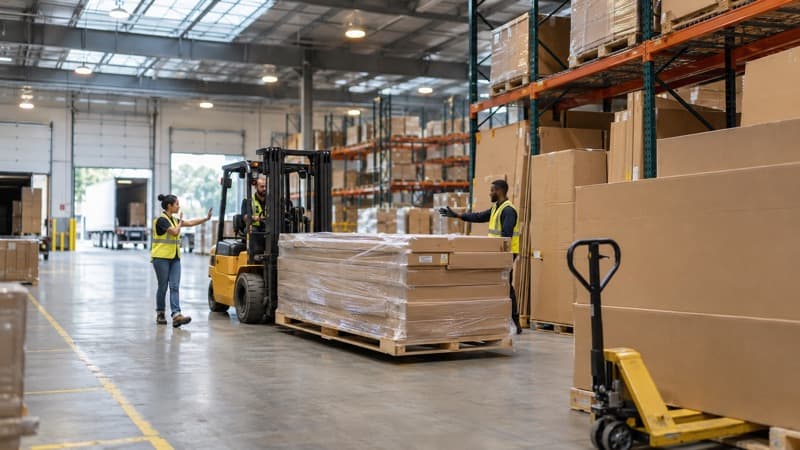
A bulky specialist plans for floor space, equipment and freight from the first inbound. These six checks show whether a 3PL is really built for large items.
3PLs specializing in large, bulky fulfillment run a different operation from a parcel warehouse that occasionally accepts a big box. The difference shows up in how they store, handle, pack and ship each SKU. So the useful test is not whether a provider says "oversized" on its website, but whether its daily process was built around products one person can't lift.
This guide covers what to look for when you are comparing providers, and which answers suggest the work really is a specialty.
What makes a 3PL a large and bulky specialist?
A bulky specialist treats size as the starting assumption. A standard parcel workflow assumes an item fits a shelf, a tote and a stock carton, and travels with a parcel carrier. A specialist plans for floor space, equipment and freight from the first inbound.
| Area | Standard parcel 3PL | Large and bulky specialist |
|---|---|---|
| Storage | Shelves and bins | Floor positions, bulk racking and stacked pallets |
| Handling | One person picks by hand | Forklift, pallet jack and team lift |
| Packing | Stock carton sizes | Heavy-duty, reinforced or custom-built packaging |
| Rating | Parcel weight | Dimensional weight, freight class and density |
| Transport | Parcel carriers | Large parcel, LTL, FTL and specialized carriers |
| Delivery | Doorstep drop | Dock, liftgate or white-glove where it is available |
A provider doesn't need to look exactly like the right-hand column for every product. A catalog of mid-size cartons may never need a full trailer. But if most of that column is an exception at the warehouse you are evaluating, large items will be handled as exceptions too.
Six things to check before you shortlist a provider
1. Whether it captures dimensions and weight at receiving
Ask what happens when a new SKU arrives. Large parcels are priced on dimensional weight and freight on class and density, so wrong carton data tends to come back later as a re-rate on an invoice. A specialist should measure and weigh each oversized SKU on receipt and keep the figures on the item record.

2. Whether storage is sized to your cartons
Share your real carton dimensions and ask where each SKU would sit. Good answers name a location type, such as a floor position, a bulk rack or a pallet stack, and mention how high that carton can safely be stacked. A vague promise of "plenty of space" tells you little, because the question is whether the space fits your product at your volume.
3. Whether handling is defined per SKU
Ask which of your items would be forklift, pallet jack or two-person picks, and how the pick task tells the associate. Handling rules that live on the item record are repeatable. Handling rules that live in one experienced person's head are not.
4. Whether packing is chosen for the trip
A carton that survives a pallet may not survive a parcel network, and the reverse is also true. Ask how packaging changes with the shipping mode: reinforced cartons, edge protection, strapping and pallet decking for freight, or protective packaging for anything moving as a large parcel. Some products also need work before they leave, so if yours do, read Light Assembly Before Shipping: When Your 3PL Finishes the Product Before It Leaves.

5. Whether it rates across modes before booking
The mode decision should come before the pick, since it changes how the order is built. Ask who decides between large parcel, LTL and FTL, and what information they use. Our comparison of parcel vs LTL for heavy orders explains how carrier size limits shape that choice.
6. Whether it is honest about the final mile
Liftgate and white-glove delivery normally belong to the carrier and depend on the lane, the destination and the product. Be cautious of any provider that promises room-of-choice placement for every address. A more useful answer explains how it confirms what a destination supports before the order ships.
Questions that separate specialists from generalists
Bring these to the first call, and ask for a walkthrough of a real SKU rather than a general description:
- What share of the orders in this building need equipment or a second person to pick?
- Who owns the decision to move an order from parcel to freight?
- How are multi-carton orders kept together until the carrier scan?
- What does the damage process look like, and where in the flow are cartons checked?
- What do you need from us to quote accurately?
That last question matters most. A provider that wants carton dimensions, weights, stackability and destination mix before pricing is treating your product as a physical object. Our guide on what to put in the scope before you request a quote lists the details to prepare.
Where IDCEA fits
IDCEA runs oversized item fulfillment as its own workflow through partner warehouses in Southern California, for products such as furniture, fitness equipment, industrial parts and large home goods. Inbound oversized goods are measured, weighed and photographed on receipt, then stored in floor, bulk or rack space sized for the SKU. We compare the parcel, LTL and specialized freight options that fit before booking, and confirm what a destination supports before the order ships.
If you are comparing providers, send your carton dimensions and weights with your quote request so we can respond against your real products.