
Parcel or LTL for Heavy Orders: Where Carrier Size Limits Change How Bulky Goods Ship
Heavy and bulky products force a choice between parcel and LTL freight. How carrier size limits, delivery locations and full-cost comparisons decide which way each order ships.
Heavy and bulky products force a decision that small-parcel sellers never think about: does this order ship as a parcel, or does it go on a pallet as LTL (less-than-truckload) freight? Get it wrong in one direction and you pay parcel surcharges on something that should have been freight. Get it wrong in the other and you put a single box on a pallet and a freight truck when a parcel carrier would have taken it.
This article walks through where the line between parcel and LTL sits, what changes operationally on each side, and how a fulfillment warehouse makes the call order by order.
Where the parcel network stops
The major U.S. parcel networks are built around packages one person can handle. Their published service guides set hard limits, which commonly include:
- A maximum weight per package, generally around 150 lb.
- A maximum length for the longest side.
- A maximum combined size, measured as length plus girth (twice the width plus twice the height).
Packages that exceed those limits are usually not accepted into the standard parcel network at all. And well before the hard limits, packages that are long, heavy or awkward trigger additional-handling and oversize charges. Carrier rules and thresholds change, so always check the current service guide for the carriers you use rather than relying on a number you remember.
Our breakdown of oversize parcel surcharges covers how carriers flag bulky packages inside the parcel network. This article is about the step beyond that: when a shipment should leave the parcel network entirely.
What LTL changes
LTL freight moves palletized shipments that share trailer space with other shippers' freight. Compared with parcel, it changes several things at once:
| Parcel | LTL freight | |
|---|---|---|
| Unit of handling | Individual carton | Palletized (or crated) shipment |
| Pricing basis | Weight, dimensions, zone | Freight class, weight, lane, accessorials |
| Pickup | Scheduled daily pickup or drop-off | Booked per shipment |
| Delivery | Doorstep, usually no appointment | Often dock-to-dock; residential needs extra services |
| Documentation | Label | Bill of lading plus label |
For business-to-business deliveries to a receiving dock, LTL is routine. For a consumer at home, it adds complexity: residential delivery, liftgate service and delivery appointments are typically billed as accessorial charges. Our article on freight class and accessorials explains how those line items build up.

How a warehouse decides, order by order
A well-run oversized fulfillment operation doesn't guess. It works from data captured before the first order ever ships:
- Accurate carton dimensions and weights at receiving. Every SKU's shipping carton is measured and weighed, not copied from a supplier spec sheet. A few inches of error can move a package across a surcharge threshold.
- A rule per SKU, then per order. A single sofa section might always ship LTL; a set of dining chairs might ship as parcels individually but LTL when the order includes four or more boxes.
- Rate comparison at the order level. Multi-carton orders are the grey zone. Several heavy parcels can cost more than one consolidated pallet — or less, once residential accessorials are added. The comparison has to include every charge on both sides.
- The customer's delivery location. A business with a dock and forklift is a natural LTL destination. A second-floor apartment is not, and may call for a different last-mile service altogether, such as threshold or white-glove delivery.
Packing is different on each side
Parcel-bound bulky goods need to survive conveyors, sorters and being handled one carton at a time: double-wall cartons, corner protection, and internal blocking so the product can't shift.
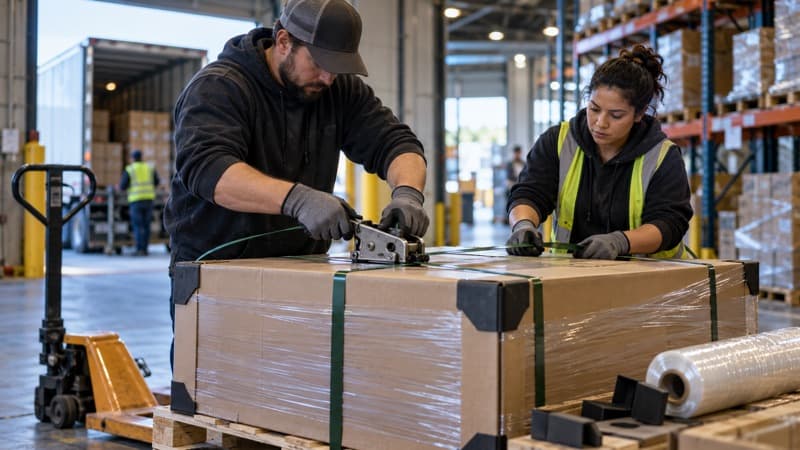
Freight-bound goods need to survive forklifts and being stacked against other freight. That means a sound pallet, cartons that don't overhang the edges, corner boards, strapping or stretch wrap, and clear labeling on more than one side. A pallet that arrives leaning is often a pallet that was built badly, not one that was handled badly.
Common mistakes
- Letting product dimensions stand in for carton dimensions. Carriers bill the box, not the item inside it.
- Treating the decision as permanent. Rates and carrier rules change; review the parcel-versus-LTL rules for your largest SKUs periodically.
- Ignoring the consumer experience. A freight delivery that requires an appointment call surprises customers who expected a doorstep drop. Say so at checkout.
- Splitting a multi-box order without checking the total. Shipping pieces of one order by different modes can mean pieces arrive days apart.
The takeaway
The parcel-or-LTL choice isn't a single threshold; it's a set of rules built on measured cartons, real delivery locations and full-cost comparisons. Put the data in place at receiving and the decision becomes routine instead of a debate on every large order.