China to Amazon FBA: Shipping Factory Direct or Through a U.S. Prep Center
Shipping from China to Amazon FBA means choosing between factory-direct delivery and a stop at a U.S. prep center. What the factory has to get right, where errors get caught, and how to choose.
Amazon sellers who manufacture in China face the same routing question on every production run: should the factory ship straight to Amazon's fulfillment centers, or should the goods land at a U.S. prep center first? Both routes work. They fail in different ways, and the right one depends on how far you trust the factory to do Amazon prep, how many SKUs are in the run, and whether you want stock held in reserve.
The two routes from China to Amazon FBA
Route 1: factory direct to FBA. The supplier labels units with your FNSKUs, packs cartons to Amazon's requirements, applies FBA carton labels, and the freight forwarder delivers the shipment straight to the fulfillment centers Amazon assigns.
Route 2: factory to a U.S. prep center, then to FBA. The supplier packs to your carton spec, the container or air shipment comes into the U.S., and a prep center receives, inspects, labels and preps the units before building the FBA shipments.
| Factory direct to FBA | Through a U.S. prep center | |
|---|---|---|
| Who does Amazon prep | The factory | The prep center |
| Where errors are caught | At Amazon receiving, after the fact | At the prep center, before Amazon sees them |
| Inventory held outside Amazon | None | Whatever you choose to keep back |
| Shipment splits across FCs | Must be built at origin | Built in the U.S. after the stock arrives |
| Extra handling step | No | Yes, one receiving and one outbound |
What the factory has to get right if it ships direct
When a factory ships straight to Amazon, it is doing the prep center's job without anyone in the U.S. checking the work. The common failure points are:
- FNSKU labels. Each unit needs the FNSKU for your listing, scannable and covering the manufacturer barcode. A label printed at the wrong size, placed on a curved surface, or applied to the wrong variant is not caught until Amazon receives it. The supplier needs your label files and written placement rules, not just a list of SKUs.
- Poly bags and protective packaging. Loose, soft or multi-piece items need bagging, with suffocation warnings where Amazon requires them. Fragile items need enough protection to survive FC handling. The details of what Amazon checks are in FBA Packaging Service: Poly Bags, Bubble Wrap and the Carton Rules Amazon Checks.
- Carton contents and labels. Box content information has to match what is physically in each carton, and each carton needs its own FBA label. Mixed-SKU cartons packed loosely at the factory are a frequent source of receiving discrepancies.
- Shipment plans. Amazon may split one shipment across several fulfillment centers. With direct shipping, those splits have to be planned and labeled at origin, before the goods leave China.
If your supplier has done FBA prep for other sellers and you can verify their work, direct shipping can run well for a small number of simple SKUs. The risk rises with every variant, bundle or fragile item added to the run.

Where a U.S. prep center earns its place
Routing through a prep center adds one receiving and one outbound step. In exchange, you get:
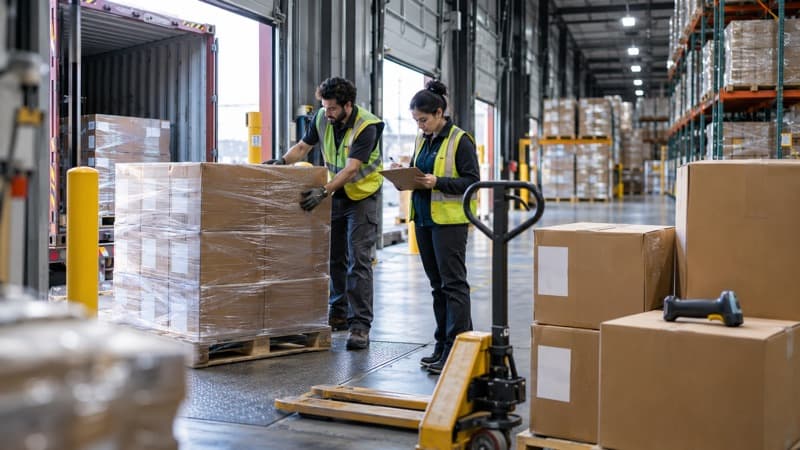
- An inspection point before Amazon. Units are counted against the supplier's packing list and checked for visible damage or short-shipping on receipt. You find out about a short carton or a wrong color while you can still do something about it.
- Prep done in one place, to one standard. FNSKU labeling, poly bagging, bundling and protective packaging are applied by a team doing the same work every day, rather than by a factory line that changes from one order to the next.
- Reserve stock outside Amazon. You can send Amazon only what it will accept now and hold the rest, which matters when inventory limits tighten or when the same production run also supplies your own store or wholesale buyers.
- Shipment plans built after arrival. Cartons are packed and labeled for the fulfillment centers Amazon assigns at the time of shipping, not weeks earlier at origin.
Why Southern California matters on this route
Most ocean freight from China to the U.S. West Coast arrives through the Los Angeles and Long Beach ports. A prep center near those ports keeps prep on the same side of the country as the container: goods clear the port, come to prep, and go out to Amazon without crossing the map first. What happens between the port and the prep dock, including drayage and container unloading, is covered in From Port to FBA: How Imported Container Freight Becomes an Amazon Shipment.
IDCEA runs Amazon FBA prep services through partner warehouses in the Los Angeles, Ontario and Riverside corridor: receiving and inspection, FNSKU labeling, poly bagging, bundling, carton prep and forwarding to the fulfillment centers Amazon assigns.
What to send your supplier either way
Whichever route you choose, a short written spec for the factory prevents most problems:
- Master carton spec: units per carton, carton dimensions and weight limits, and whether cartons may contain mixed SKUs.
- Unit packaging: bag type, protective packaging and any warning labels required for the product.
- Labeling instructions: for direct shipping, the FNSKU files and placement rules; for the prep-center route, plain carton marks showing SKU and quantity so receiving can count quickly.
- Packing list and photos: SKU, quantity and carton numbers per shipment, plus photos of packed cartons, sent before the goods depart.
Choosing a route
Direct to FBA suits a small, simple catalog and a supplier with a proven FBA track record. A U.S. prep center suits sellers with many variants, bundles, fragile goods, or stock that also feeds other channels, and anyone who would rather catch a factory mistake in California than in an Amazon receiving report. If you are weighing the prep-center route for goods arriving through the Southern California ports, contact us with your SKU count and shipment volume.