
FTL Fulfillment: When a Wholesale Order Fills a Whole Trailer
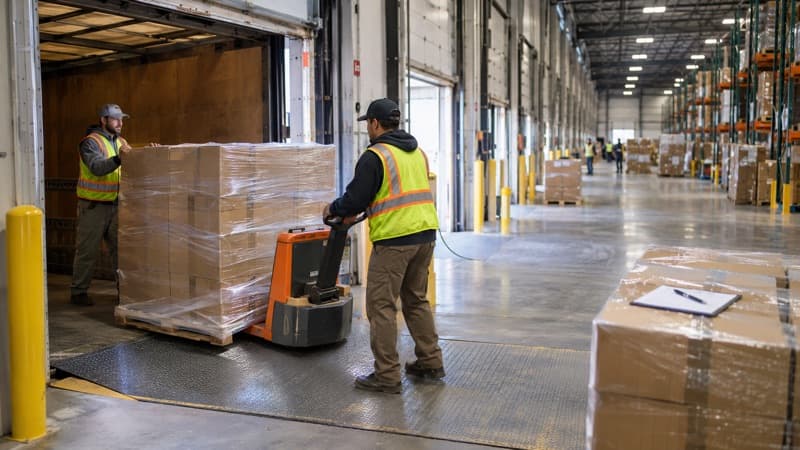
How FTL fulfillment works for wholesale and retail orders: when a full truckload beats LTL, how a trailer is planned and secured, live vs drop trailers, and what the buyer's routing guide controls.
FTL fulfillment is what happens when a wholesale or retail order is big enough to fill a trailer on its own. Instead of handing a few pallets to an LTL carrier that will mix them with other shippers' freight, the warehouse loads one full truckload (FTL) that goes from its dock to the buyer's dock without being rehandled at a terminal.
That sounds simpler than LTL, and in some ways it is. But a full trailer shifts the work: load planning, weight distribution, the choice between live and drop trailers, and appointment timing all matter more when one truck carries the whole order.
When an order should move as FTL
There is no single cutoff, but the decision usually comes down to three things:
- Pallet count. A standard 53-foot dry van has floor space for roughly 26 standard 48 x 40 pallets loaded straight, a few more if pallets are turned. Once an order approaches half a trailer or more, a dedicated truck often prices close to, or below, several LTL shipments.
- Weight. A loaded trailer is limited by road weight rules, which typically leaves roughly 42,000–45,000 lb for cargo depending on the tractor and trailer. Dense goods can "weigh out" a trailer long before they "cube out" the floor.
- Handling risk. LTL freight passes through terminals and gets moved between trailers. If the product is fragile, high-value or easy to crush, keeping it on one trailer from dock to dock removes those touches.
Many buyers make the decision for you: large retailers often route full loads through their own carrier program, and the routing guide says when an order must ship as a truckload.
How a full truckload gets planned

A full trailer is planned before the first pallet is picked:
- Pallet builds. Cases are picked and built to the buyer's pallet pattern and height limit. Our guide to LTL pallet height and weight limits covers the same build rules, which carry over to truckloads.
- Load sequence. If one trailer carries several POs or will stop at more than one location, pallets are loaded in reverse order of delivery so the first stop's freight is at the door.
- Weight distribution. Heavy pallets go low and are spread along the trailer rather than piled at the nose, so the axles stay within limits.
- Securing the load. Load bars or straps hold the last rows in place, and gaps are filled so pallets cannot shift under braking.
- Seal and paperwork. The trailer is sealed, the seal number goes on the bill of lading, and the ASN is sent so the receiving dock knows exactly what is on the truck.
Live load or drop trailer
| Live load | Drop trailer | |
|---|---|---|
| How it works | The driver waits at the dock while the trailer is loaded | An empty trailer is left at the dock and picked up later |
| Best for | Smaller or irregular full loads | Regular, repeating loads to the same buyer |
| Main risk | Detention charges if loading runs past the free time | Trailer availability and yard space |
Neither is better in general. A drop trailer gives the warehouse room to load carefully; a live load avoids holding a trailer at the dock. Either way, the order must be staged and ready before the truck is scheduled to load.
What the buyer's routing guide controls
When the freight is going to a retailer or large distributor, the routing guide usually decides more of the shipment than the shipper does:
- Who books the truck. Many retailers use a collect, routed program: you request a pickup through their portal and their carrier arrives. Others leave carrier choice to the shipper.
- Delivery appointments. Distribution centers receive full loads by appointment. Arriving outside the window can mean a refused load or a fine.
- Labels and ASN. Every pallet and carton still carries compliant labels, and the ASN has to match what is physically on the trailer.
- Floor-loaded vs palletized. Some buyers accept floor-loaded cartons in a full trailer; most DCs want pallets built to their spec.
Misses here usually show up as chargebacks rather than as a phone call, which is why the guide is captured before the first order ships.
FTL vs LTL at a glance
| Factor | LTL | FTL |
|---|---|---|
| Typical size | 1 to about 10 pallets | Most or all of a trailer |
| Pricing basis | Freight class, weight, lane, accessorials | Lane and equipment, mostly per truck |
| Handling | Through terminals, cross-docked | Dock to dock, sealed |
| Scheduling | Pickup window | Specific load and delivery appointments |
If most of your orders are still a few pallets, case picks, pallet builds and LTL is the better starting point. FTL becomes relevant as individual POs grow, or when several POs for the same buyer can be consolidated into one trailer.
Running FTL alongside parcel and LTL orders
Most brands that ship truckloads also ship smaller wholesale orders and online orders from the same inventory. The practical challenge is that a full load ties up dock space, labor and inventory at once, so it has to be planned around daily parcel cutoffs. Distribution Center Fulfillment: Running Wholesale Pallets and Online Parcels From One Building looks at how those flows share one floor without one starving the other.
How IDCEA handles FTL orders
IDCEA's B2B fulfillment covers case and pallet picking, building pallets to each buyer's routing guide, EDI 856 ASNs and freight booking: LTL for partial loads and FTL when an order fills a trailer. We use the buyer's routing carrier where one is specified, book the delivery appointment and return the BOL, PRO and tracking.
The work runs through partner warehouses in the Los Angeles, Ontario and Riverside corridor. For importers, that means containers that clear the Los Angeles and Long Beach ports can move into wholesale distribution without a cross-country leg first, and outbound truckloads start on the I-10 and I-15 freight corridors.
To scope an FTL program, it helps to share typical order size in pallets, pallet weights, the buyers involved and whether they route their own carriers.