
UCC-128 Labeling Service: What Your 3PL Needs Before Retail Cartons Ship
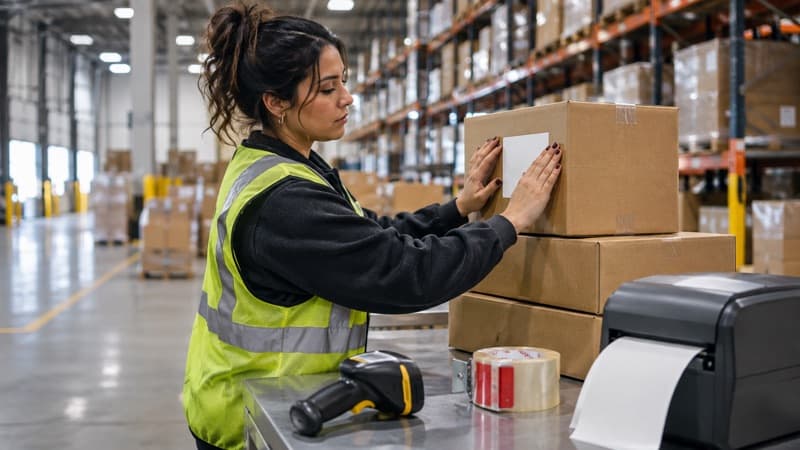
What a UCC-128 labeling service covers, the data your 3PL needs first, how labels tie to the ASN, and the questions to ask before handing over retail carton labeling.
A UCC-128 labeling service is the warehouse work of generating, printing and applying the serialized shipping labels a retailer scans when your cartons and pallets arrive. The label itself is simple. The service is worth paying for because each label has to match your purchase order and your advance ship notice, carton by carton.
Almost any warehouse can print the label. The useful questions are who owns the data behind it, what you need to supply, and what happens when something does not match.
What is a UCC-128 labeling service?
UCC-128 is the older name for what GS1 now calls a GS1-128 label; the Uniform Code Council behind the original name has since become GS1 US. Retail routing guides and suppliers still use both names for the same thing. The label carries an 18-digit Serial Shipping Container Code (SSCC) that identifies one specific carton or pallet, not a product.
A labeling service typically covers:
- Label setup per retailer, using the layout in that retailer's routing guide
- SSCC generation, so no number is issued twice
- Printing and application to the placement rules for each carton or pallet
- Scan verification that the printed barcode reads
- Data hand-off so the same carton contents feed the ASN
If you want the anatomy of the label itself, including the zones and pallet-level rules, our guide to Retail Carton and SSCC Pallet Labels walks through it. This article is about buying and running the service.

What your 3PL needs from you first
Most delays with a new labeling program come from missing inputs rather than from the printer. Before the first order, plan to supply:
| Input | Why it is needed |
|---|---|
| Retailer routing guide | Sets the label layout, placement, and ASN timing |
| GS1 Company Prefix | SSCCs are usually built on the supplier's own prefix, so it has to be yours or one you are permitted to use |
| Vendor, department and store numbers | These fill the order and mark-for zones on the label |
| Item master with UPCs and case packs | Lets the warehouse tie carton contents to the correct items |
| Carton plan or case-pack rules | Decides whether a carton is single-SKU or mixed, which changes the label and the ASN |
| EDI or portal access details | Connects the purchase order to the shipment record |
If you do not have a prefix, sort it out with GS1 US before the first retail order.
How a labeling job runs in the warehouse
A retail order usually moves through these steps:
- The purchase order arrives by EDI or through a vendor portal.
- Cartons are planned against the case-pack rules and the order quantities.
- Units are picked and scanned into each carton, which records the contents.
- The carton label prints at close, carrying an SSCC tied to that record.
- Cartons are scanned onto a pallet, which gets its own SSCC label where the retailer requires one.
- The ASN is built from those scans and sent before the shipment leaves.
Step 6 is the one to ask about. EDI for Retail Orders: What the 850, 856 and 810 Actually Do in Fulfillment explains how those documents connect. A label that scans perfectly can still cause an exception if its SSCC is missing from the ASN or describes different contents.
Problems should also surface before the truck does. A missing store number or an unmapped item ought to stop the order where someone can see it, which is what Order Exception Queues: How Warehouse Software Surfaces Stuck Orders Before They Miss the Truck covers.
Questions to ask a labeling provider
- Where are SSCCs generated? A system that issues and logs them is safer than a spreadsheet of number ranges, which is how duplicates start.
- Is the ASN built from carton scans? If labels and ASNs are produced separately, they can drift apart.
- How are reprints handled? A damaged label should be replaced without creating a second record for the same carton.
- How do you set up a new retailer? A routing guide should be configured once and applied on each order, not reinterpreted by whoever is on shift.
- Who pays for an error? Agree in advance how a deduction caused by warehouse error is handled compared with one caused by bad order data.
Be cautious of any promise of zero chargebacks. The receiving door belongs to the retailer, and a 3PL cannot guarantee how each one will apply its own rules.

What drives the cost
Labeling is usually quoted as part of a wider retail program rather than as a flat rate, so compare scope and not just a per-label figure. The main drivers are:
- Carton count, since each carton gets its own label
- Mixed cartons, which take more scanning than single-SKU cases
- Pallet labels and placement rules, which add handling
- Retailer setup, as each new routing guide takes configuration
- Related work, such as price ticketing, case-pack changes or relabeling inbound stock
Inbound stock that arrives with supplier labels may also need old barcodes covered before retail labels go on. Mention that up front so it is scoped rather than discovered at the dock.
When to hand it to a 3PL
Printing labels in-house can work for one retailer and a handful of orders. As you add different layouts, mixed cartons and ASN deadlines, labeling becomes a data-matching job that fits better on the floor where cartons are picked and packed.
IDCEA runs UCC-128 and GS1 carton labeling as part of its retail fulfillment services, through partner warehouses in the Los Angeles, Ontario and Riverside corridor. Each account's routing guide is set up once and applied on the line, with carton labels generated per shipment so they match the ASN the retailer expects to receive. Send your routing guide and a sample purchase order, and the scope can be priced from those.