
Heavy Product Fulfillment Service: Storing, Picking and Shipping Dense 40–150 lb Items
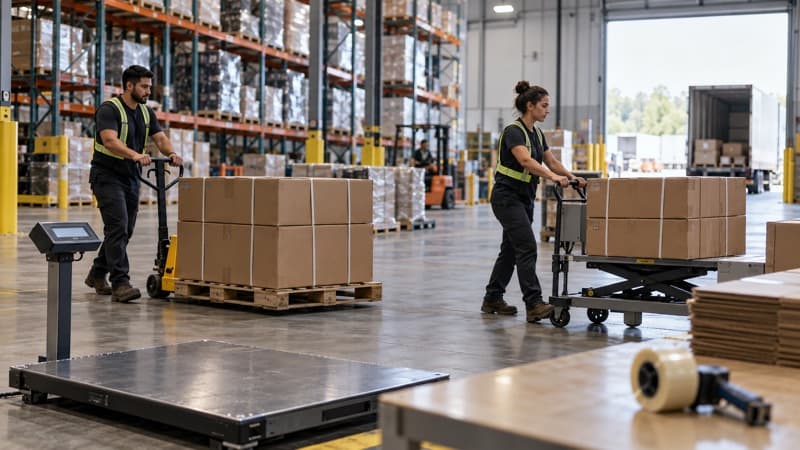
What a heavy product fulfillment service does differently for dense items: rated storage, team-lift and equipment picks, packaging built for the weight, and parcel-or-freight decisions.
A heavy product fulfillment service is a 3PL operation set up for items that are dense rather than just big: products in the 40–150 lb range that fit in a normal-looking carton but cannot be picked off a shelf, tossed on a conveyor or packed like a t-shirt. Think boxed dumbbells and kettlebells, cast-iron cookware sets, tile and stone samples, bagged goods, power tools, small engines and machine parts.
Weight changes almost every step between receiving and carrier pickup. This article walks through what an operation does differently when the product is heavy, and what to put in front of a 3PL before you ask for a quote.
Heavy is not the same as oversized
Oversized products are a dimensions problem: the carton is long, tall or awkward, and dimensional weight drives the shipping bill. Heavy products are a mass problem: the carton may be small, but it is hard to lift, hard on packaging and close to carrier weight limits.
Many SKUs are both, and the handling overlaps. But a dense 60 lb carton the size of a shoebox breaks different rules than a light 8-foot carton, so it is worth knowing which one you have:
| Question | Mostly oversized | Mostly heavy |
|---|---|---|
| What limits storage? | Cube and footprint | Shelf and beam load ratings |
| What limits picking? | Reach and maneuvering | Lift weight per person |
| What drives parcel cost? | Dimensional weight | Actual weight and handling surcharges |
| What fails in transit? | Corners and long edges | Carton bottoms, seams and tape |
Receiving and storage: where heavy goods sit
Heavy cartons are received on pallets and broken down with a pallet jack or forklift, not by hand-stacking from a floor-loaded container wherever that can be avoided. Each SKU is weighed and measured on receipt and the figures are stored on the item record, because every later step — slotting, packaging choice, carrier rating — reads from those numbers.
Storage follows the weight:
- Floor and low beam levels for the heaviest SKUs, so picks happen at waist height rather than overhead.
- Rated shelving and racking — light-duty shelving that suits apparel can sag or fail under a few cartons of fitness equipment.
- Pallet-quantity storage for fast movers, picked straight from the pallet instead of being re-slotted into bins.
Picking and handling: equipment and team lifts
The biggest operational difference is how a unit leaves its location. Light ecommerce orders are picked by one person with a cart; heavy orders need a plan:
- Lift-weight thresholds. Items above a set weight are flagged in the warehouse management system (WMS) as two-person or equipment picks, so they are not assigned to a single picker on a standard route.
- Equipment rated for the load. Pallet jacks, lift-assist carts and forklifts move the product; associates guide it rather than carry it.
- Staging space. A heavy item needs somewhere to be set down between pick and pack. Balancing a 70 lb carton on a cart while someone finds a box is how product and people get hurt.
- Order routing. Heavy single-unit orders are often batched and sent to a dedicated pack station near the dock, away from the fast parcel line.

Packaging that holds the weight
Dense products fail packaging in predictable ways: carton bottoms blow out, seams split when the box is dropped on a corner, and the product shifts and punctures the side. Heavy product packaging usually means:
- Double-wall or heavy-duty cartons with a strength rating chosen for the packed weight, not the cheapest box the item fits.
- Fixed internal positioning — molded pulp, foam end caps or corrugated inserts — so the product cannot move inside the carton.
- Reinforced closure: wider or water-activated tape, and strapping on the heaviest units.
- Pallet packaging for freight: stretch wrap, corner boards and strapping when the order ships as LTL.
We go deeper on carton construction and drop-test logic in protective packaging for heavy and oversized goods.
Shipping: parcel limits, surcharges and freight
Weight decides which mode an order can travel in. Major parcel carriers cap a single package at 150 lb, and packages above lower weight thresholds typically attract additional-handling charges. Past those points — or once several heavy units go to one address — LTL freight often becomes the better option, with pallet build, freight class and liftgate needs to plan for.
Accurate weights matter here more than anywhere. If the item record says 45 lb and the packed carton weighs 52 lb, the carrier re-rates the package and the difference shows up later as an adjustment on the invoice. Our comparison of parcel vs LTL for heavy orders explains where each carrier limit kicks in.
What to send a 3PL before you ask for a quote
A heavy-goods quote is only as good as the data behind it. Send:
- Per-SKU weight and dimensions, packed and unpacked, plus how each SKU arrives (cartons per pallet, pallet height).
- Order profile — share of single-unit orders, typical units per order, and how many orders exceed parcel weight limits.
- Destinations — residential or commercial, and whether any need liftgate or inside delivery.
- Packaging — whether your product ships in its own carton or needs overboxing, and any retailer packaging rules.
- Returns — heavy returns are expensive to move, so say how you want them inspected and dispositioned.
Where IDCEA fits
IDCEA handles heavy and bulky products through partner warehouses in the Los Angeles, Ontario and Riverside corridor in Southern California: floor and bulk storage sized to the SKU, forklift and two-person team-lift handling, heavy-duty packaging, and parcel or LTL shipping depending on the order. Size and weight limits depend on the building, the equipment and the packaging, so we confirm them against your actual SKU data. See our oversized and heavy item fulfillment page for how the service is scoped, or contact us with your SKU list.