
Warehouse Storage in Riverside, CA: Inland Empire Space for Port-Bound Inventory
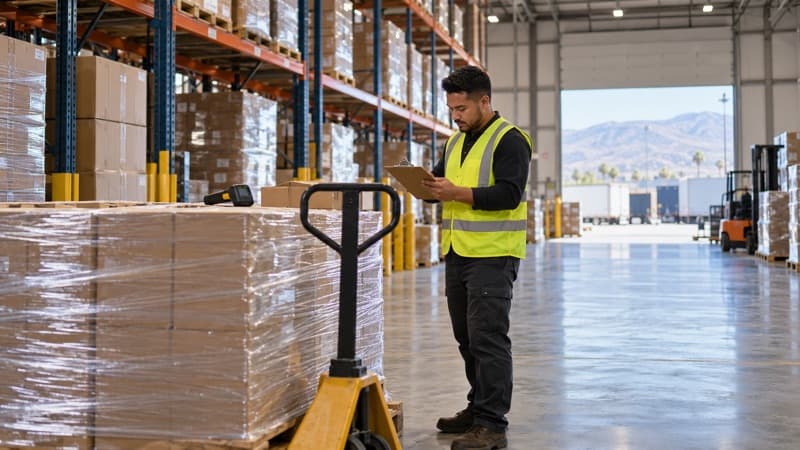
What warehouse storage in Riverside, CA is suited for, how inventory arrives from the LA and Long Beach ports, how storage is charged, and what to send for a quote.
Warehouse storage in Riverside, CA means holding business inventory on the Inland Empire side of Southern California: inland from the Los Angeles and Long Beach ports, on the I-10 and I-15 freight corridors, in buildings designed for pallets and cartons rather than household goods. It suits importers, ecommerce brands, distributors and manufacturers who need stock in California without paying for space right next to the ports.
This guide covers what Riverside storage is good for, how inventory gets there and back out, how it is usually charged, and what to have ready before you ask for a quote.
Who warehouse storage in Riverside is for
Riverside is not where you store a few boxes from a garage. Commercial storage here is built around businesses moving inventory in volume:
- Importers whose containers clear the Los Angeles and Long Beach ports and need somewhere to land without a cross-country leg first
- Ecommerce brands holding reserve stock in California to replenish fulfillment or marketplace inventory
- Distributors and wholesalers staging pallets for retail and B2B orders across California and the western states
- International sellers keeping inventory in the U.S. so domestic customers are served from a domestic address
- Seasonal or overflow inventory that has outgrown a backroom, a store or another warehouse
If your goods are personal belongings, you want a self-storage unit. If they are products you sell, count and ship, you want a business warehouse that records every pallet and carton by SKU and location.
Why the Inland Empire rather than next to the ports
The ports drive most of Southern California's freight, but storage right beside them is in high demand. Riverside and Ontario sit further inland, and the trade-off is straightforward:
| Consideration | Near the ports | Riverside / Inland Empire |
|---|---|---|
| Inbound from LA / Long Beach | Shortest dray | A longer dray, still no cross-country leg |
| Outbound lanes | Into the LA basin | On the I-10 and I-15 corridors toward the rest of California and the western states |
| Typical use | Short holds, transloading | Longer storage, distribution, fulfillment |
We cover the regional choice in more depth in Warehousing and Storage in California: Port Basin, Inland Empire or a Second Location. For many businesses the practical answer is that storage capacity is easier to find inland, and the extra drayage is a small part of the total cost of holding inventory for months.
How inventory gets into a Riverside warehouse

Most inbound arrives in one of three forms:
- Floor-loaded containers. Cartons stacked directly on the container floor are unloaded by hand, sorted by SKU, palletized and labeled. This takes the most labor and needs the most notice.
- Palletized containers or LTL. Pallets come off with a forklift, are checked against the packing list and put away.
- Parcel inbound. Smaller replenishments arrive as cartons and are received individually.
Customs clearance and the ocean leg stay with your customs broker and freight forwarder. The warehouse receives goods once they have cleared and arrive at the dock, and coordinates the delivery appointment with your forwarder or drayage carrier.
What matters most at receiving is the paperwork: a packing list that matches the cartons, carton labels or SKU markings that can be read, and an advance notice of what is coming. A container that arrives with no packing list is received slowly and counted twice.
How stock is tracked while it sits

Good warehouse storage gives every pallet an address. In practice that means:
- Each pallet or carton is recorded by SKU and location at putaway
- On-hand and available quantities are visible to you, not only to the warehouse
- Every movement — receipt, putaway, release, adjustment — is recorded as it happens
- Counts are checked on a schedule, so differences show up while they are still small
If a provider cannot tell you where a specific pallet is without walking the building, that is the problem storage is supposed to solve.
How Riverside warehouse storage is usually charged
Storage-only pricing is built from a few inputs:
- Billing unit — per pallet position, per shelf or bin, or per cubic foot
- Duration — monthly, often with a minimum term
- Handling — receiving, palletizing floor-loaded freight, labeling and outbound release are charged separately from the space itself
Our guide to warehouse storage billing units compares how those units work. The cheapest storage rate is not always the cheapest arrangement once handling is added in.
Storage on its own, or with fulfillment
Warehousing and fulfillment often happen in the same building, but they are different services. Storage is charged on space and time; fulfillment is charged on orders and units. Many businesses start with storage only and add order fulfillment later, or keep reserve stock in Riverside while a separate operation ships orders.
Amazon sellers are a common example: inventory is held and prepped in California before it moves into Amazon's network. Amazon FBA Warehouse in California: Choosing Where Your Inventory Gets Prepped Before Amazon walks through how that split works.
What to send when you ask for a Riverside storage quote
A useful storage quote needs a few numbers:
- Volume — pallet count or cubic feet, and whether the goods arrive palletized
- Duration — how long you expect to hold the inventory
- Inbound profile — floor-loaded containers, palletized freight or parcels, and how often
- Outbound profile — full pallets, cartons, or units into fulfillment
- Product notes — weight, stackability, and anything that needs special handling
Where IDCEA fits
IDCEA provides warehousing through partner warehouses in the Los Angeles, Ontario and Riverside corridor, and our office is in Riverside. We staff and coordinate the operation; we do not own the buildings. Inbound from the Los Angeles and Long Beach ports arrives without a cross-country leg, and outbound reaches the I-10 and I-15 lanes. If a specific location matters for your inbound or outbound, ask and we will tell you what is actually available. See our warehousing services for receiving, pallet and SKU storage, inventory control and outbound release.