
Heavy, Bulky Palletizable Warehousing: Rack Ratings, Floor Stacking and Pallet-In, Pallet-Out Storage
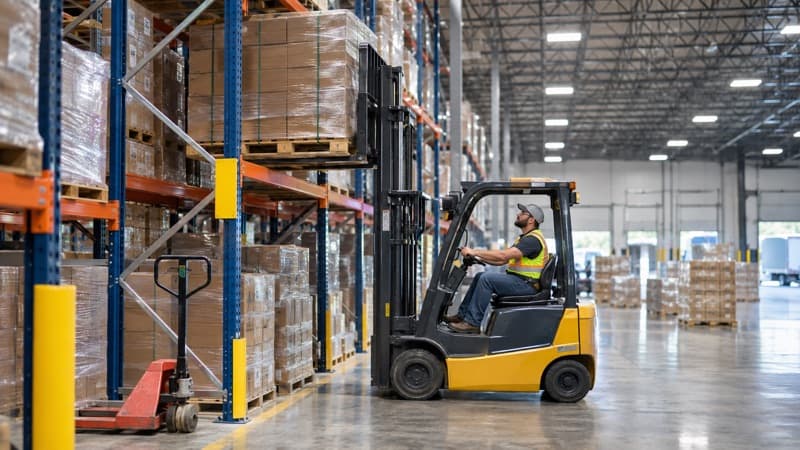
How warehouses store heavy, bulky goods that move as whole pallets: rack load ratings versus floor stacking, receiving checks, pallet-in, pallet-out releases, billing and what to send for a quote.
Heavy, bulky palletizable warehousing is storage for goods that are too dense or too big to shelve, but arrive and leave as whole pallets: bagged material, tile and stone, fitness equipment, flat-pack furniture, appliances, machine parts. The product is hard to handle one unit at a time, yet a forklift can move it all day as long as the pallet is sound and the location is rated for it.
That combination changes the questions worth asking a warehouse. Shelf space and pick speed matter less. Rack load ratings, floor-stacking rules, pallet condition and how stock is released matter a lot more. This guide covers how that storage works and what to send before asking for a quote.
What makes freight "palletizable"
A load is palletizable when it can sit on a standard pallet, be wrapped or strapped into one unit, and be lifted by forklift without the product itself taking the stress. In practice that means:
- The footprint fits the pallet. Cartons or bags stay inside the pallet edges instead of hanging over them, where they get crushed by forks and neighbouring loads.
- The load is stable. Cartons are stacked in a pattern that interlocks, and the pallet is wrapped or banded so it moves as one piece.
- The pallet can carry the weight. A worn pallet with broken deck boards under a dense load is a storage hazard, not a storage unit.
Goods that fail these tests can still be stored, but they move into floor locations and specialised handling — a different service with different pricing. If your pallets need rebuilding on arrival, Palletizing Services: Stack Patterns, Stretch Wrap and Repalletizing at a 3PL explains what that work involves.
Rack positions or floor stacking
Heavy pallets go to one of two places, and the choice is driven by the load, not by preference:
| Selective pallet racking | Floor (block) stacking | |
|---|---|---|
| Best for | Many SKUs, mixed quantities, partial releases | Few SKUs in deep quantity, whole-pallet releases |
| What limits it | Beam and upright load ratings per level | How much weight the bottom pallet and its packaging can bear |
| Access | Every pallet reachable on its own | Last in, first out within each stack |
| Risk to watch | Overloading a beam level | Crushed cartons in the bottom layer |
Racking is the default when you hold many SKUs or release a few pallets at a time. Every rack bay carries a load rating per beam level; the heaviest pallets go to the lower levels, and a pallet that exceeds the rating does not go into that bay at all.
Floor stacking suits deep quantities of the same SKU that leave in full pallets. Whether pallets can be stacked two or three high depends entirely on the packaging. Bagged goods and sturdy double-wall cartons often stack; retail-packed boxes and anything with a soft top usually do not.

Receiving heavy pallets
Most of the risk in this kind of storage shows up at the dock, so receiving does more than count pallets:
- Book the delivery against your packing list or ASN so the dock and equipment are ready.
- Inspect each pallet for broken boards, leaning loads, torn wrap and crushed corners, and photograph damage before anything is signed for.
- Weigh and measure a representative pallet per SKU. The weight decides which rack levels it may go to and whether it can be stacked.
- Count against the paperwork and report shortages and damage before the stock becomes available.
- Put away to a recorded location — a specific rack position or floor lane — so every pallet has an address in the inventory record.
Floor-loaded containers of heavy goods need one extra decision: unload and palletize at the dock, or ask the shipper to palletize at origin. Palletizing at origin usually makes the receiving faster and more predictable.
Pallet-in, pallet-out releases
Much heavy, bulky inventory never gets broken down. It comes in as pallets and leaves as pallets, to a distributor, a retailer DC, a job site or a customer's own truck. A release normally means:
- Retrieving the pallets you name by SKU and quantity
- Checking them against the release and re-wrapping where needed
- Staging them at the dock and loading to the LTL carrier, full trailer or pickup you nominate
- Recording the outbound so on-hand counts update when the truck leaves
If some of that stock also ships as single units to consumers, picking and parcel packing are a separate workflow. Our guide to heavy product fulfillment covers that side.
How the storage is billed
Heavy palletized goods are normally billed on the pallet positions they occupy, rather than per unit or per cubic foot. Two things move that number: how tall your pallets are (a tall pallet can take a full rack opening on its own) and whether the packaging allows floor stacking. The comparison in Warehouse Storage Billing Units: Pallet, Shelf, Bin and Cubic-Foot Charges Compared shows how each unit plays out.
What to send before you ask for a quote
- Pallet count and turnover — how many pallets you expect to hold, and how often they come in and go out
- Pallet specs per SKU — footprint, height and gross weight, and whether the load can be stacked
- Inbound profile — palletized or floor-loaded, and how often deliveries arrive
- Release profile — full pallets, partial pallets or single units, and who collects them
- Any special handling — clamp-only loads, fragile tops, items that cannot be wrapped
Where IDCEA fits
IDCEA provides pallet storage and warehousing through partner warehouses in the Los Angeles, Ontario and Riverside corridor in Southern California. Palletized goods are stored in rack positions, or floor-stacked where the packaging takes the weight, and billed on the positions actually occupied. Receiving, inventory records by SKU and location, and outbound release to the carrier or truck you nominate are part of the same service. Send us your pallet specs and expected volume and we will confirm what fits before you ship.